no start, no spark

1991 FORD F-150
200,000 MILES • 5.0L • V8 • 4WD • AUTOMATIC
Avatar
NEGGEN
  • MEMBER
  • 16 POSTS
drove this truck yesterday about twenty miles and it ran fine. Got home and left idling to check the cows, got back in a few minutes later and it shut off when trying to accelerate. started back up fine but would shut off under load. Today it would not start at all. Fuel pressure is okay, but no spark. Tested it using a timing light. Had a pre-existing check engine light (just bought this truck a few weeks ago) so I checked the codes. The codes showed 113 (ACT), 116 (ECT) and 636 (Transmission oil temperature out of range). Not sure where to go next. ICM maybe? ECM maybe? I checked the inline fuses by the starter relay and they're fine, but I'm not sure if they are the right ones. Thanks!
Apr 9, 2022 at 1:08 PM

Advertisement
Avatar
KASEKENNY
  • Experienced Mechanic
  • 18,907 POSTS
There are a number of things that can cause this, so we need to track the spark back to the TFI module.

The way we do this is check the voltage going to the coil from the TFI module and find out if it is commanding it on.

I suspect it is not which means we will need to take the next steps.

Here is a guide that will help with this:

https://www.2carpros.com/articles/how-to-check-wiring

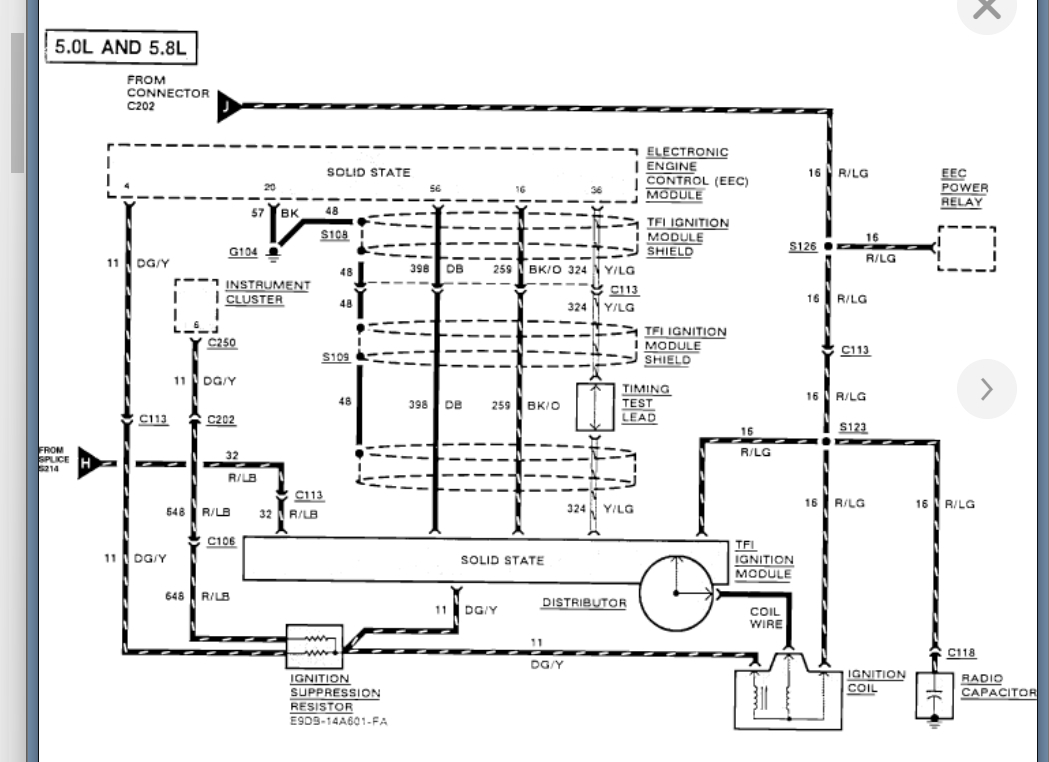
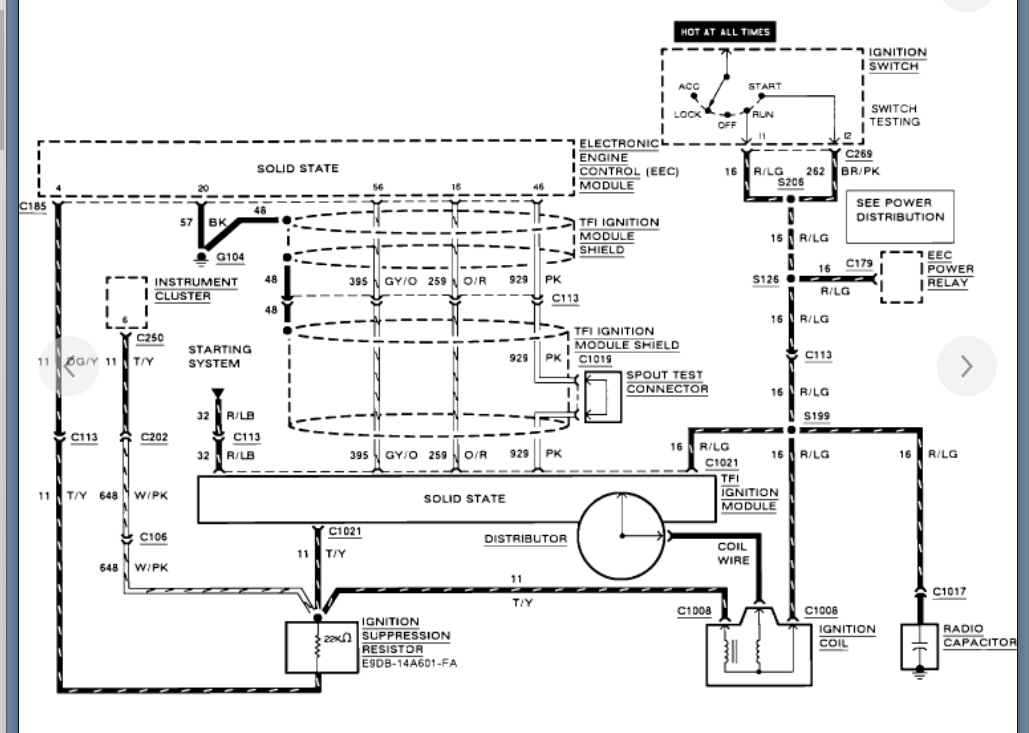
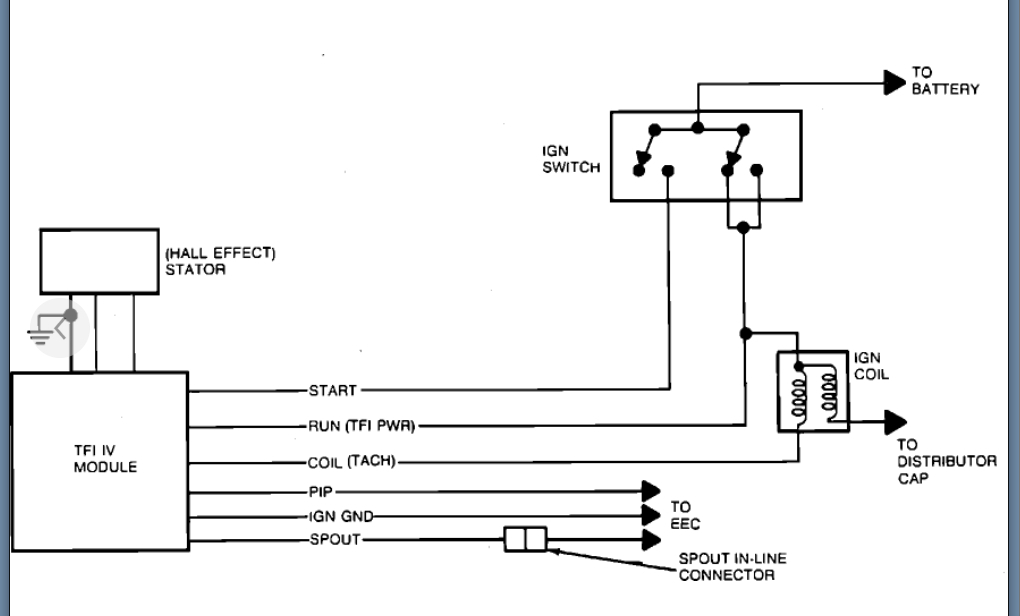
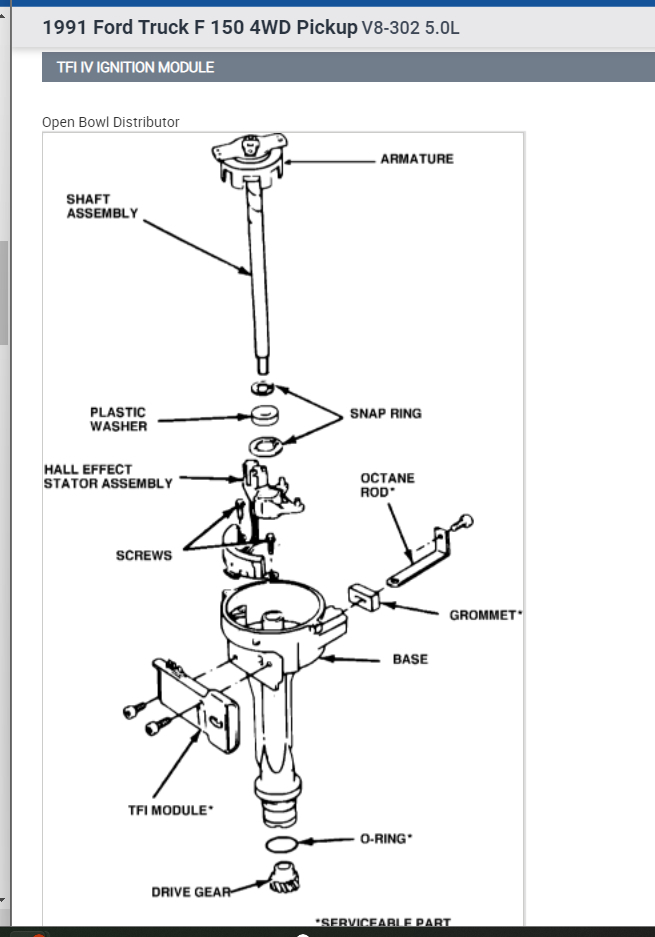
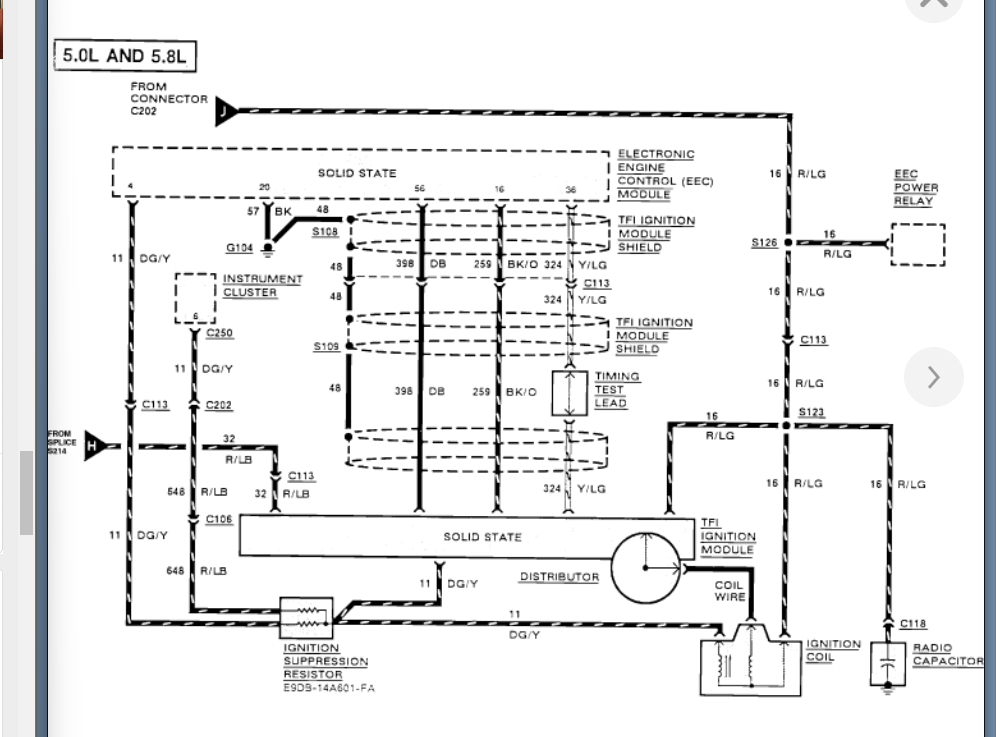
I am attaching the wiring diagrams that will help with this but the last is a good diagram that is going to show what we need. Basically, the hall sensor is the crank sensor that we need to get a signal from and then find out if the TFI module is sending the signal.

That will tell us what we need to know so let's start with this and go from there.

Thanks
Apr 10, 2022 at 12:56 PM
Avatar
NEGGEN
  • MEMBER
  • 16 POSTS
Okay. so, I confirmed that the TFI and the coil are getting power (red/light green wire). I took the connection off the coil and checked the power from the TFI to the coil (tan/yellow wire) and nothing. I read up on the TFI in those Fords and due to their proximity to the engine block they get hot and fail often. Could this be the issue here?
Apr 11, 2022 at 3:49 AM
Avatar
KASEKENNY
  • Experienced Mechanic
  • 18,907 POSTS
That is exactly what I was going to reference as well. Have seen numerous times where they get hot and fail. Based on this info, I would suggest replacing it.
Apr 13, 2022 at 1:33 AM
Avatar
NEGGEN
  • MEMBER
  • 16 POSTS
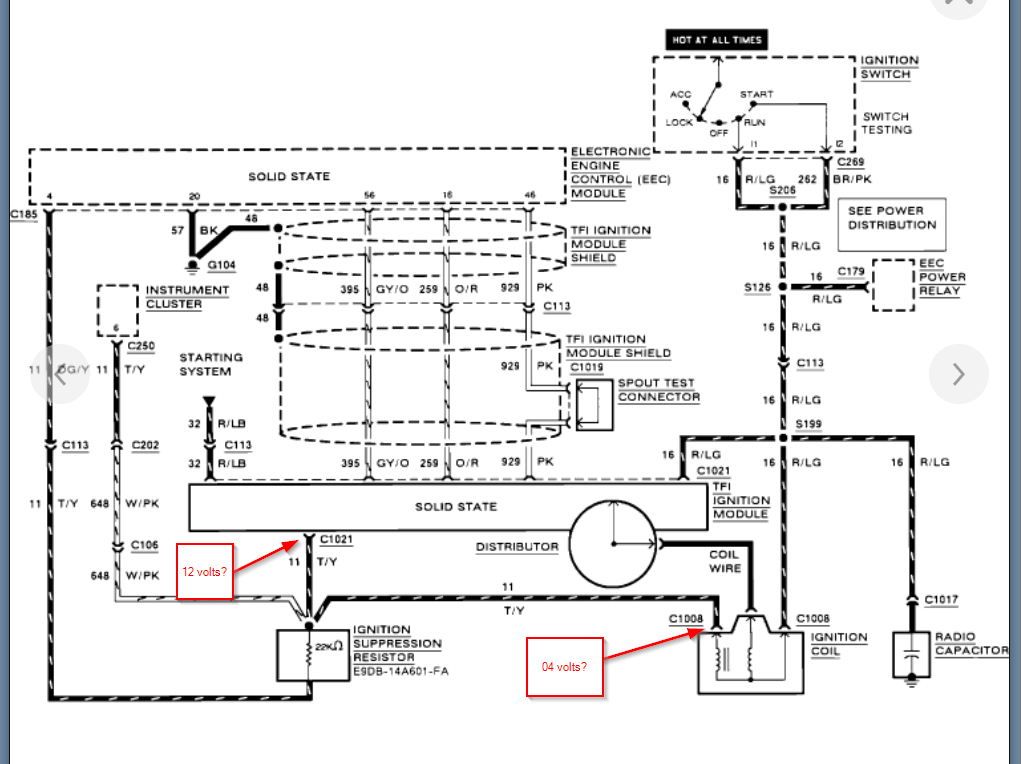
Well, I jumped the gun and replaced it along with cleaning all the grounds that I could find. Still no start. There was one point where it tried to fire once but then nothing. There is 0.4 volts coming into the coil from the TFI with the key on now. When I replaced the module, I did so by marking the position and then turning the distributor enough to access the screws. I didn't remove it completely. Is there a chance I screwed something up when doing that?
Apr 13, 2022 at 7:52 AM
Avatar
KASEKENNY
  • Experienced Mechanic
  • 18,907 POSTS
Okay. Let's step back and let me know what voltage you have on the red and light green wire when trying to start the engine.

I assume you have .4 volts on the wire from the coil to the TFI module? If that is the case, then we are missing voltage somewhere else so let's check this and go from there.

Thanks
Apr 14, 2022 at 9:09 AM
Avatar
NEGGEN
  • MEMBER
  • 16 POSTS
Yes, it’s .4 volts from the TFI to the coil with no change when I’m cranking on it. The red and light green has 12 volts when the key is on and drops to 9.5 when cranking on it.
Apr 15, 2022 at 4:45 AM
Avatar
KASEKENNY
  • Experienced Mechanic
  • 18,907 POSTS
Okay. The dropping to 9.5 volts is expected as the starter is pulling a large load and pulls the voltage down. However, that is a lot so it may be worth trying to put a charger on the battery while cranking.

There is a chance that the coil is not firing due to not having close to 12 volts. However, this is unlikely.

Have you replaced the coil? If not check the resistance from the terminal of the red/light green wire and the wire to the TFI.

Let me know what the resistance is, and we can go from there.

Thanks
Apr 15, 2022 at 12:29 PM
Avatar
NEGGEN
  • MEMBER
  • 16 POSTS
The coil has not been replaced that I am aware of. The resistance across those 2 terminals reads 00.4 ohms.
Apr 16, 2022 at 3:21 AM
Avatar
KASEKENNY
  • Experienced Mechanic
  • 18,907 POSTS
That resistance appears correct, and it shows the coil is not an open circuit.

The last thing is to check the voltage on the Dark green and yellow wire.

This is the wire that will interrupt the signal and create your voltage spike. If you have voltage there, then I would replace the coil. Unless we missed something with these checks, that appears to be the issue.

However, let's check that and go from there. Thanks
Apr 16, 2022 at 9:44 AM
Avatar
NEGGEN
  • MEMBER
  • 16 POSTS
Okay, so, the diagrams you sent showed a tan/yellow wire at the coil and the other diagram showed a dark green/yellow wire. Mine has the tan/yellow so I'm assuming that's the one you're referring to? There doesn't appear to be a dark green/yellow wire in play here anywhere else unless I'm missing something. If so, the voltage on that wire shows .4 at the coil connection and 12 at the TFI connection with the key on.
Apr 16, 2022 at 1:00 PM
Avatar
KASEKENNY
  • Experienced Mechanic
  • 18,907 POSTS
Okay. Just want to make sure we are at the correct points that you are seeing this voltage.

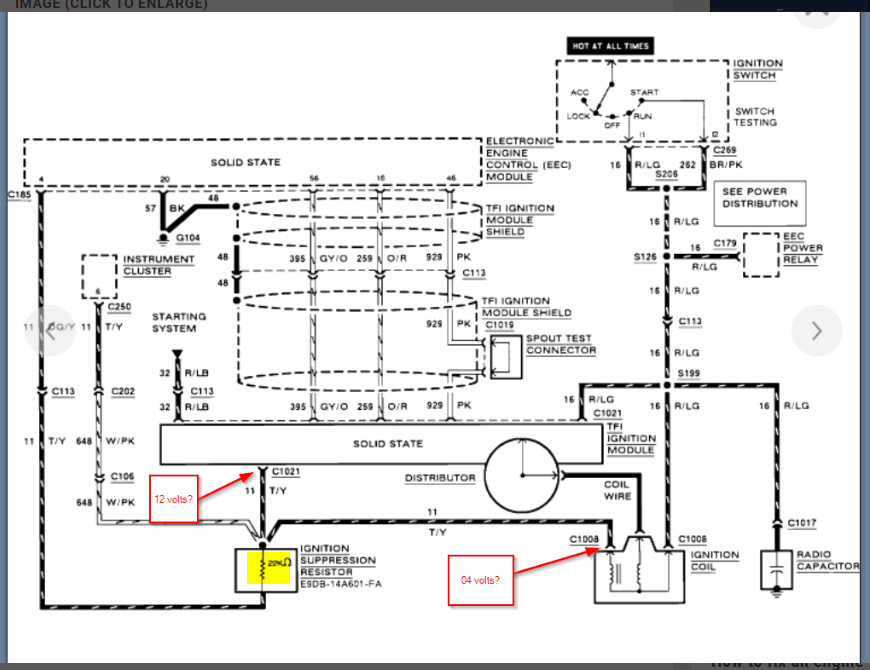
Take a look at the diagram below. If you have the tan/yellow wire, then this is the correct diagram.

If this is correct, then we need to measure the resistance across the suppression resistor. It should be 22,000 ohms.
Apr 17, 2022 at 3:13 AM
Avatar
NEGGEN
  • MEMBER
  • 16 POSTS
what you added to that chart is correct. I measured the resistance between those two points, and it bounced around a bit and ended back at zero. It never showed a value anywhere near 22,000.
Apr 17, 2022 at 4:38 AM
Avatar
KASEKENNY
  • Experienced Mechanic
  • 18,907 POSTS
Okay. That is interesting. I think we are narrowing in on it but when you checked the resistance where you on just the resistor?

Meaning did you unhook the connectors from the resistor and measure just the resistor? If the connectors were still hooked up, then you are going to get resistance through the entire circuit and that will cause it to bounce around like that.

Also, if it settled on 0 ohms that is different than an open circuit. Can you get a picture of what the circuit does when it settles out like this?

Thanks
Apr 17, 2022 at 12:28 PM
Avatar
NEGGEN
  • MEMBER
  • 16 POSTS
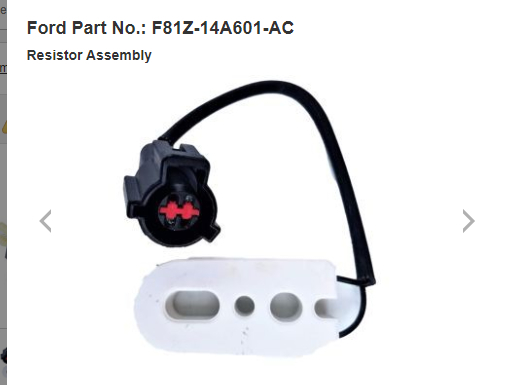
I might have misunderstood. I checked the resistance on the yellow/tan wire between the TFI connection and the Coil connection. Where is the resistor? Is that the connection that looks like it’s pigtailed off the TFI wiring harness?
Apr 18, 2022 at 9:23 AM
Avatar
KASEKENNY
  • Experienced Mechanic
  • 18,907 POSTS
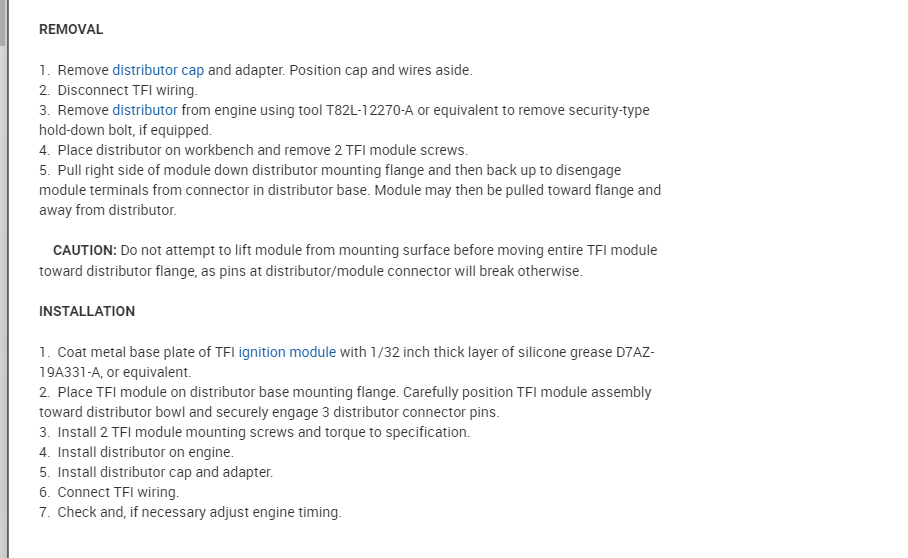
Sorry, that may have been my fault. The resistor is in the suppression resistor which is part of the wiring harness.

I am attaching the picture of the harness that contains this resistor.
Apr 19, 2022 at 7:51 AM
Avatar
NEGGEN
  • MEMBER
  • 16 POSTS
Okay, I found the resistor in the wiring harness and it showed 21.9 when I had the meter set at 200,000. I’m assuming that means 21,900 Ohms.
Apr 19, 2022 at 9:29 AM
Avatar
KASEKENNY
  • Experienced Mechanic
  • 18,907 POSTS
Perfect. So based on all this info, I think the coil is the issue. However, just to confirm you were getting .4 volts on the coil wire when you were cranking the engine or just with the key on?

If you are then this may be a TFI module issue.

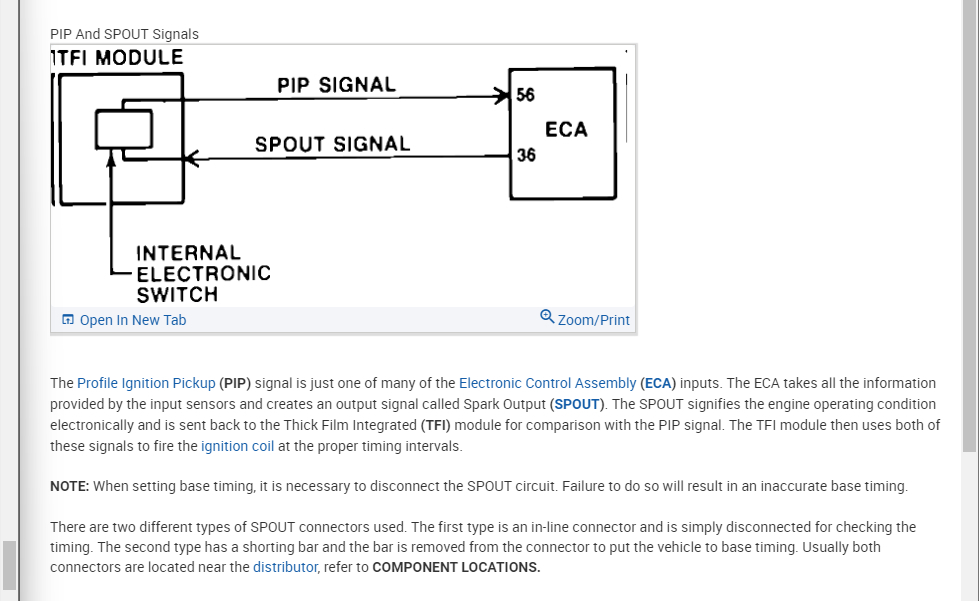
Basically, the EEC module gets the PIP signal from the TFI and then sends the signal to the coil to interrupt the signal to create the high voltage spike.

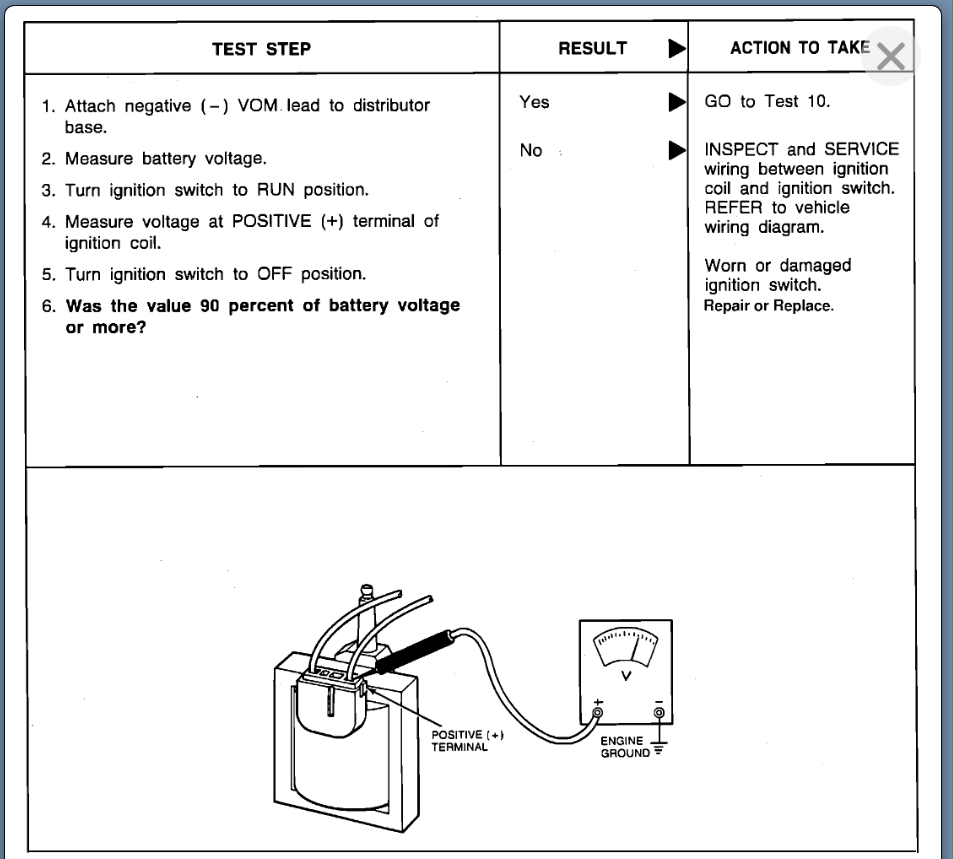
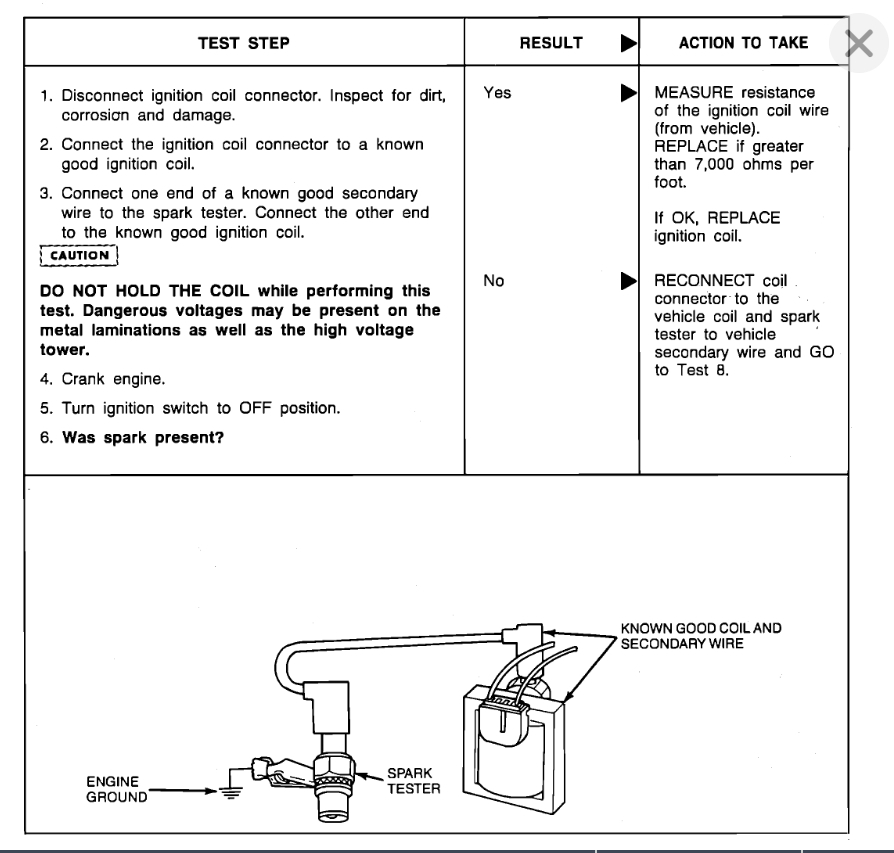
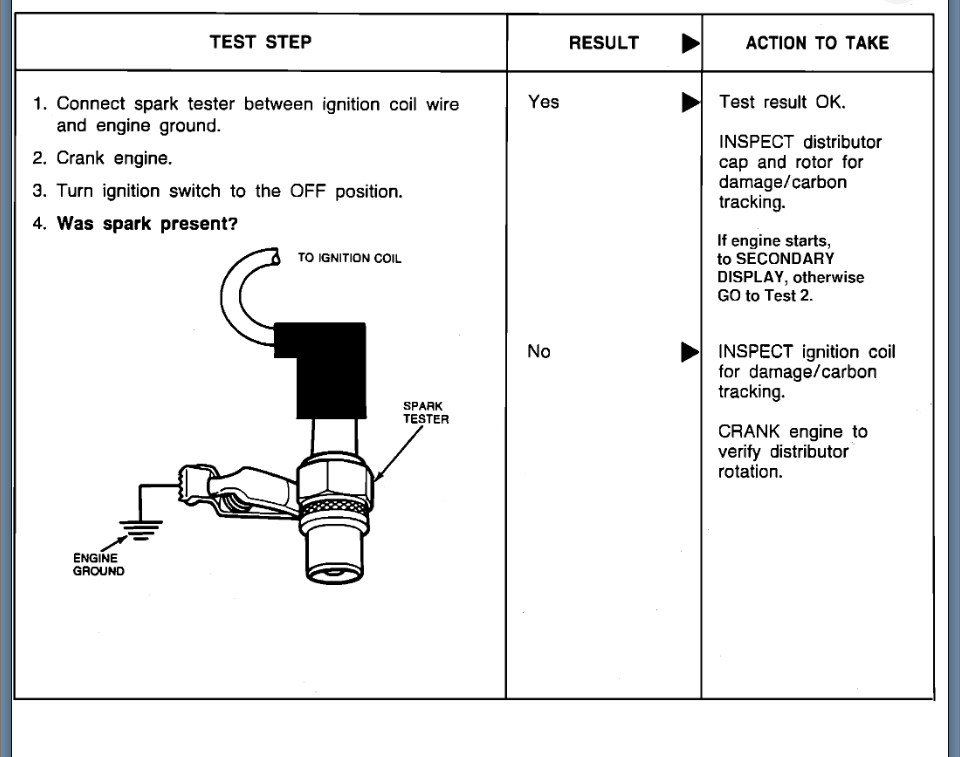
Here is a chart that helps with this and a couple tests for the coil which you may have already done but this will confirm the coil issue.
Apr 19, 2022 at 11:21 AM
Avatar
NEGGEN
  • MEMBER
  • 16 POSTS
Yes, the tan/yellow wire had .4 volts with the key on and no change when cranking. I’ll check out these other tests and report back. Thank you for everything up to this point.
Apr 19, 2022 at 1:13 PM
Avatar
KASEKENNY
  • Experienced Mechanic
  • 18,907 POSTS
Not a problem. Sounds good. We will wait to hear back. Thanks for the update.
Apr 19, 2022 at 9:59 PM
Avatar
NEGGEN
  • MEMBER
  • 16 POSTS
Okay, the voltage seems good. I don’t have a spark tester, but I put a timing light on the coil wire. It fires pretty intermittently (maybe twice in 20 seconds of cranking) and the engine will not fire properly when it does.
Apr 20, 2022 at 9:53 AM
Avatar
KASEKENNY
  • Experienced Mechanic
  • 18,907 POSTS
Okay. This is sounding more and more like a faulty coil. So, if it failed these tests then the instruction was to replace the coil? Is that correct? Meaning on the testing did it tell you to replace it? If so, let's go for it.

The only other thing that can cause this is the control module but based on all this testing it points to a coil.
Apr 21, 2022 at 12:35 AM
Avatar
NEGGEN
  • MEMBER
  • 16 POSTS
sounds good. I'll throw a new one in this weekend and see what happens. Thanks!!!
Apr 21, 2022 at 8:48 AM
Avatar
NEGGEN
  • MEMBER
  • 16 POSTS
Put in a new coil and it fired right up and runs like a champ! Thanks a lot for the help I learned a lot from this.
Apr 22, 2022 at 12:43 PM
Avatar
KASEKENNY
  • Experienced Mechanic
  • 18,907 POSTS
That is great. Thanks for the update and I'm so glad that you figured that out. You did a great job in the testing and walking through this, and I am sure that this post will help others to do the exact same thing.

Thanks
Apr 23, 2022 at 12:15 AM
Join 2CarPros for free, one of the most advanced car repair communities on the internet. From first-time drivers to seasoned mechanics, everyone is welcome to reply, share details, and get better answers. You can add a temporary image or video first; uploads are limited to 20 MB.
Ask a Free Question
Repair Safety Notice: This information is for general instructional purposes only. Vehicle repair can be dangerous. Verify all information, follow manufacturer service procedures, use proper tools and safety equipment, and consult a qualified repair shop when needed.