There's a couple of things to consider. First is the only way any voltage readings are valid is when they're taken with everything plugged in and connected. You could have a wire that has been rubbing on a bracket, or flexing, and is broken to the point it can't carry enough current, but all it takes is one tiny strand still intact, or a small spot of carbon tracking for a digital voltmeter the "see" 5.0 volts. The same is true if there's corrosion between a pair of mating connector terminals. Digital voltmeters don't require current flow to measure voltage. In this type of circuit, old-style test lights with incandescent bulbs inside do need current to flow for them to work, so they can do a better job when you don't have to know an exact voltage.
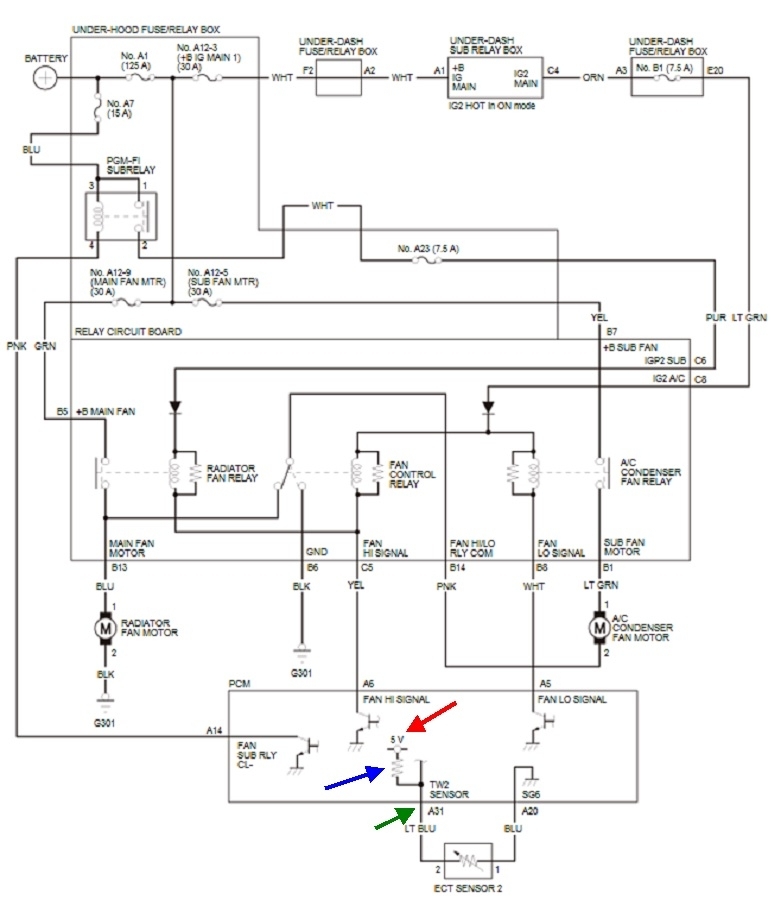
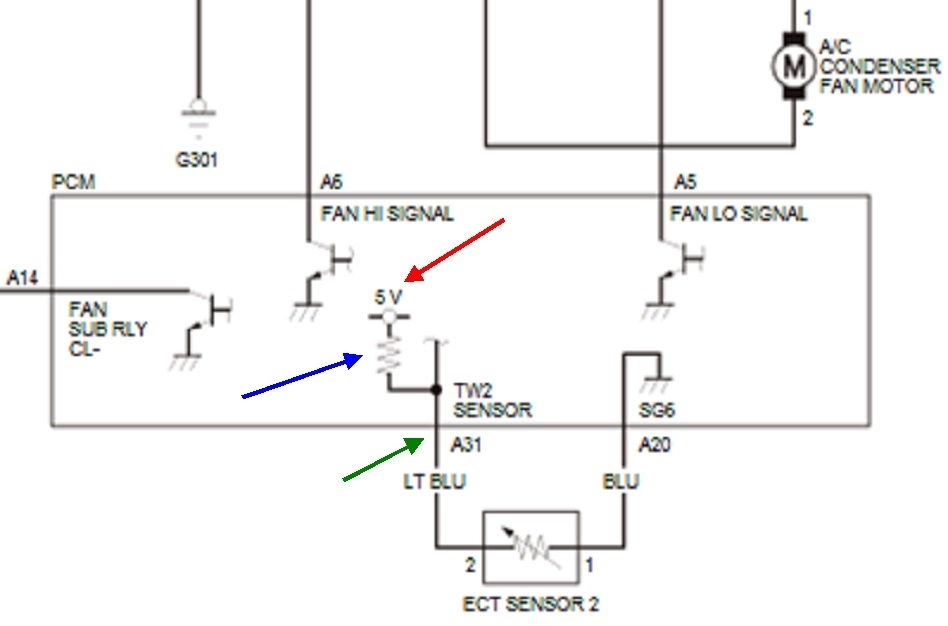
The second thing is you omitted or didn't mention the rest of the tests. This circuit starts with a very carefully regulated 5.0-volt power supply in the Engine Computer, (red arrow). Current flows through a dropping resistor, (blue arrow), then flows out on the light blue wire, (green arrow), to the sensor. It still has to flow through the sensor, then the blue wire, back to the computer, then to ground. The amount of current flow varies dependent on the resistance of the sensor. As more current flows, more of the 5.0 volts is dropped across the dropping resistor, leaving less at terminal A31. That's where you're currently getting 5.0 volts which is what sets this fault code. In most sensor circuits, especially with temperature circuits, the typical acceptable range of signal voltage is from 0.5 to 4.5 volts. Anything outside that range is what sets fault codes. The other clue is -40 degrees is the default value when the computer sees 5.0 volts due to a break in this circuit.
What you need to do is plug the sensor back in, then back-probe through the rubber weather seals alongside the wires to take the readings. Start on the light blue wire. If you still find 5.0 volts there, that wire is okay. Next measure the blue wire. If you find 0 volts, the sensor is open. That will be doubtful because temperature sensors have an extremely low failure rate because there's just one component inside them. Also, you jumped those two wires in the connector and nothing changed. That's a quick, valid test that eliminates the sensor as a suspect.
I suspect you're going to find 5.0 volts on that blue wire. That would point to that wire is broken. It should read close to 0 volts because it is a ground wire. More realistically, you'll find close to 0.2 volts on that blue wire. That's because of the small resistance in the monitoring circuitry in the computer.
If you find 0 volts on the blue wire, there's a bad connection on one of the connector terminals. Look for corrosion or a spread terminal that isn't making contact with its mate. When you do still suspect he sensor, just measure its resistance. The exact value is irrelevant. It must not measure 0 ohms or infinite resistance. A typical value to expect is around 8,000 ohms, but that is just an example.
The second diagram is expanded for easier viewing.
Images (Click to enlarge)
Mar 26, 2025 at 7:48 AM