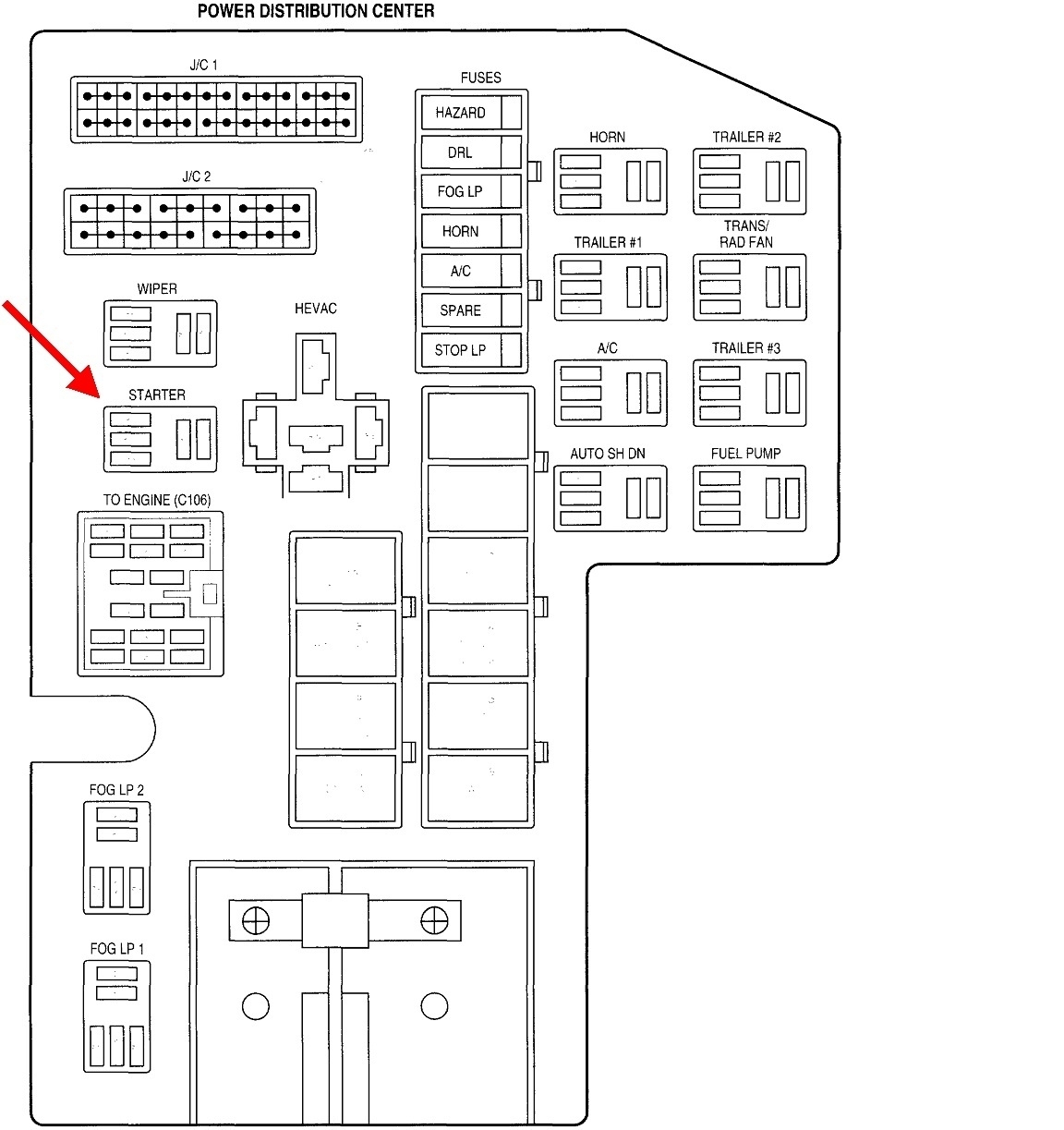
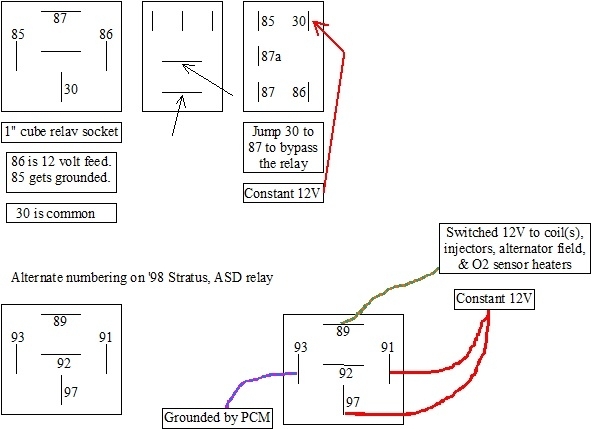
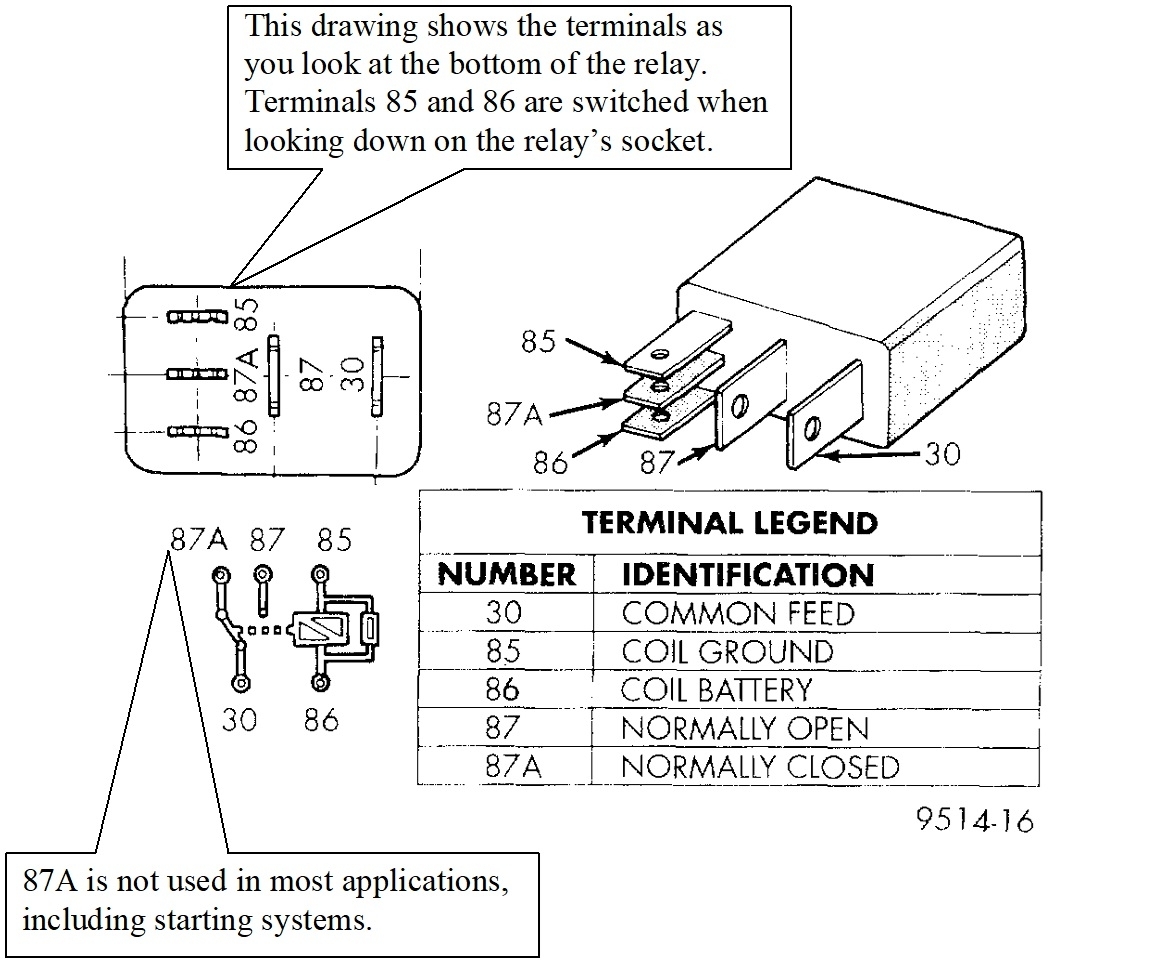
Hi guys. Sorry for the delay. There's two ways different mechanics could approach this. One is the way MECHTRIX described, by starting with the more common suspects when you know what those are. Grounds, in this case. My first career was as a tv / vcr repairman. As such, we came at it from a different angle. That is to start by testing the circuit to see what does and doesn't work, then work our way to the suspect, which could still be those grounds. The way my mind works, if you clean and shine up the ground points, then the engine starts and runs fine, is it because a ground was bad, or, as happened a year ago, it just decided to work for a while? I prefer to see for myself that incorrect voltage caused by a bad ground. To say that a different way, if you clean the grounds, the engine runs, how far out of town would you trust the diagnosis and repair? For me, it's no further than I'm willing to walk back home.
When you want to test the ASD circuit, it's best to use an old-fashioned, incandescent-type test light. Most digital voltmeters don't respond fast enough for the first part of this test. Find the wire that is the same color in every injector connector, the ignition coil(s), or you can use either smaller terminal bolted to the back of the alternator. On most Chrysler products around this time, it is the dark green / orange wire. I prefer to back-probe an injector connector alongside the wire because they're easiest to get to, and you may be able to see the test light from inside the truck. If you can't see it, you'll need a helper to turn the ignition switch.
When the ignition switch is turned to "run", you should see the test light turn on full brightness for just one second, then it will turn off. You might be able to hear the hum of the fuel pump at the same time. If the test light turns on, it proves the ASD relay and its circuitry are okay, and the computer has control of it.
Next, the test light should turn on again steady during engine rotation, (cranking or running). If it does, the crankshaft position sensor and the camshaft position sensor are both working properly. It's by their signals the computer knows it's time to turn the ASD relay back on.
If the ASD relay doesn't turn on during cranking, you'll have no spark and no fuel because the injectors and ignition coil will be dead. On this model and year, you can't use the fuel pump for a clue because it is powered through its own relay, and that is switched by the computer on a different circuit than the ASD relay.
If the ASD relay does turn on during cranking, a no-start is going to be caused by a loss of fuel pressure, a loss of spark, or a loss of injector pulses, in that order of likelihood. Unlike on GM vehicles, it is almost unheard of for a Chrysler fuel pump to fail while you're driving, so, based on your previous experience, the pump is not the better suspect here. Chrysler pumps typically fail to start up, but if they do start running, they stay running.
Loss of injector pulses is the least likely suspect because it is not likely all eight individual circuits are going to fail at the same time. The one exception to this is in the wiring harness going to them. A single wire feeds 12 volts to the injectors from the ASD relay, and that wire runs through a connector where the harness goes from the body to the engine. Through flexing from a rocking engine, and corrosion from salt and water, that is the most likely place to find a break that would affect all injectors at once. While that can certainly be intermittent, you would experience the symptoms a lot more than what you described.
The reason I asked about running out of gas has to do with getting the engine restarted. There's no long crank time like we had with carburetors. Electric fuel pumps today get the job done within a few seconds, . . . as long as they have gas to suck up out of the tank. I used to occasionally run out of gas on purpose, then dump in a measured gallon to see what I could get for fuel mileage. I learned the hard way that this won't work on some vehicles.
With fuel pumps inside the gas tank, any time you'd get below roughly a quarter tank, going uphill or around corners would make the gas run away from the fuel pickup, then the pump would starve for fuel, pressure would drop almost instantly, and the engine would stall. With carburetors years ago, there was plenty of gas in its float bowl to overcome that. Today, electric pumps sit inside a small bowl welded to the bottom of the tank. A real high volume of gas is pumped to the fuel rail on the engine, then the majority of that gas flows through the pressure regulator, then back through a return line, into the tank where it flows up a ramp, around the bowl, and into the bowl. Through venturi action, it draws additional fuel into the bowl to keep it full.
What I found on my '88 Grand Caravan was when I'd pour in a gallon of gas, it dumped right into that bowl. That's where the fuel pickup screen sits, so it only took a pint of gas to get the engine to restart.
The gas tank on my '94 Grand Caravan worked the same way, but the gas missed that bowl when being poured in. On that model, I had to pour in at least five gallons for the level to get high enough to overflow into the bowl, then the engine could start. Once running, the returning gas kept the bowl full all the way down to an empty tank. I brought this up because every once in a while, someone would come here and tell us the engine was running fine until they ran out of gas, and then it wouldn't restart. All ya gotta do on some models is add more gas at first, then you can run it low again after that.
To add another comment of value to what MECHTRIX said about bypassing stuff, the Engine Computer does operate the ASD relay by switching the ground to its coil on and off. Some people will try to add a jumper wire to the relay to bypass the computer, but when the computer is not supplying the ground for the relay, it's because of a missing signal from the crankshaft position sensor or the camshaft position sensor, and with that missing signal, the computer won't know when to fire an injector or the ignition coil, so the engine still won't run. This entire system, with the two sensors and the ASD relay, is a very important safety system, so no mechanic would ever consider trying to modify or bypass it. In the event you're in a crash where a fuel line is ruptured, the fuel pump could remain running, dumping raw gas onto the ground, creating a major fire hazard. Instead, with no fuel pressure, no fuel can spray from the injectors. The engine stalls, then there's no signal pulses from either sensor. With no signal pulses, the computer turns the ASD relay, (and the separate fuel pump relay on this model), off. That stops the fuel pump.
Let us know what you find up to this point, then we'll figure out where to go next.
Sep 28, 2026 at 7:31 PM