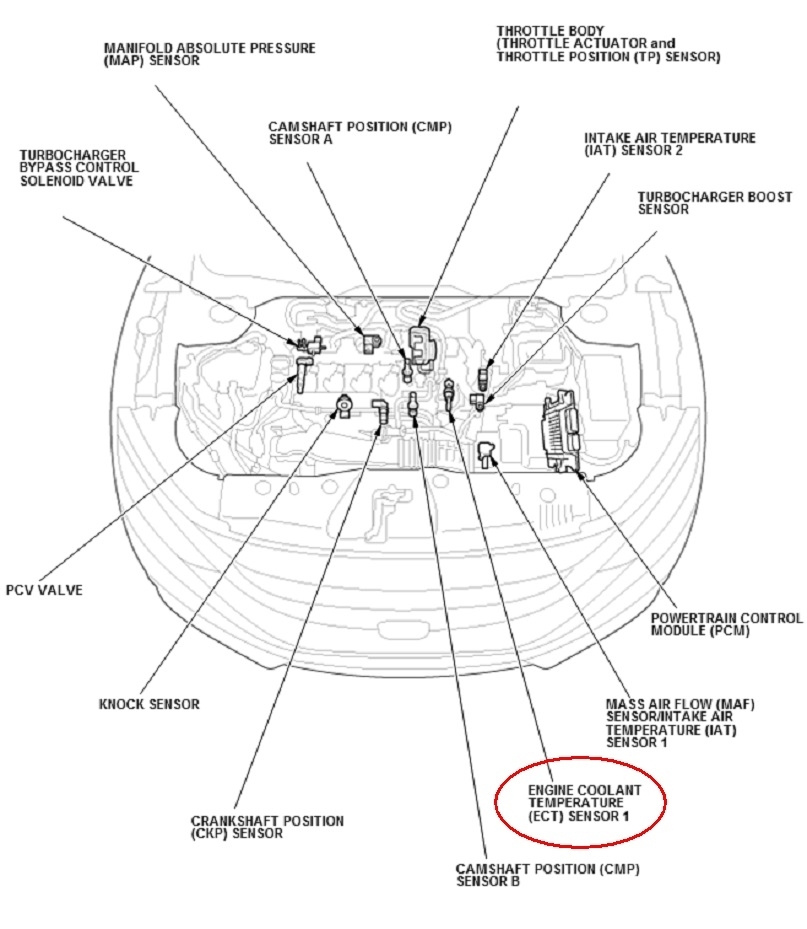
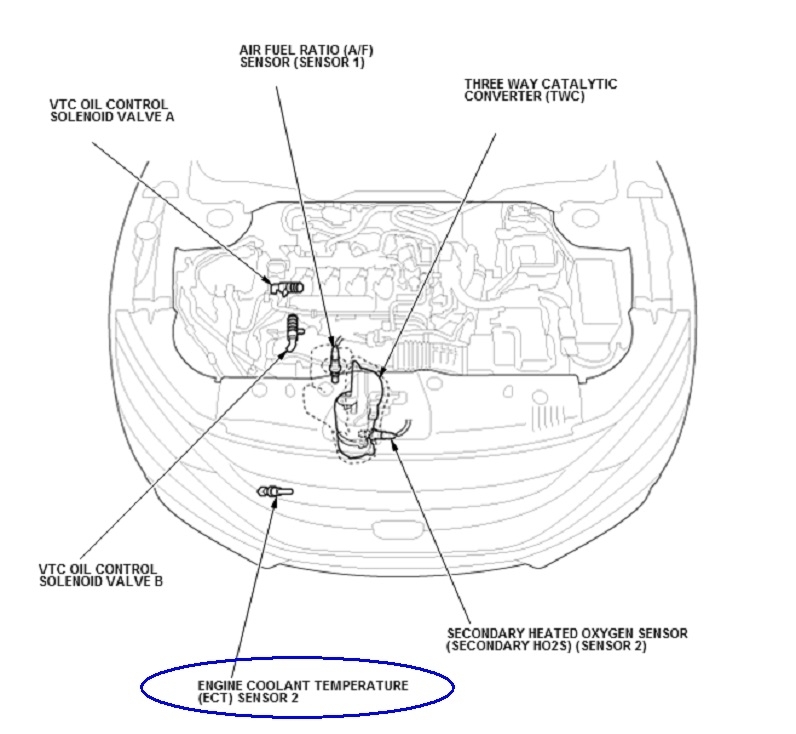
Years ago, most cars had two coolant temperature sensors. The two-wire sensor was for the Engine Computer. Those were always very accurate. The single-wire sensor was for the dash gauge. No two of those ever read exactly the same. In later years, just the two-wire sensor was used, and engine data was sent digitally to the instrument cluster. When you have a second sensor on such a new model, it is almost always as a back-up to run the radiator fan. That is evidenced here by its location at the coldest part of the radiator.
As for the Check Engine light, your Engine Computer can detect well over 2,000 defects and set very specific diagnostic fault codes for each of them. Only about half of those codes refer to something that could adversely affect emissions. Those are the codes that turn on the Check Engine light. The sensor on the engine will affect emissions, then a code related to it would have a different number and turn the light on.
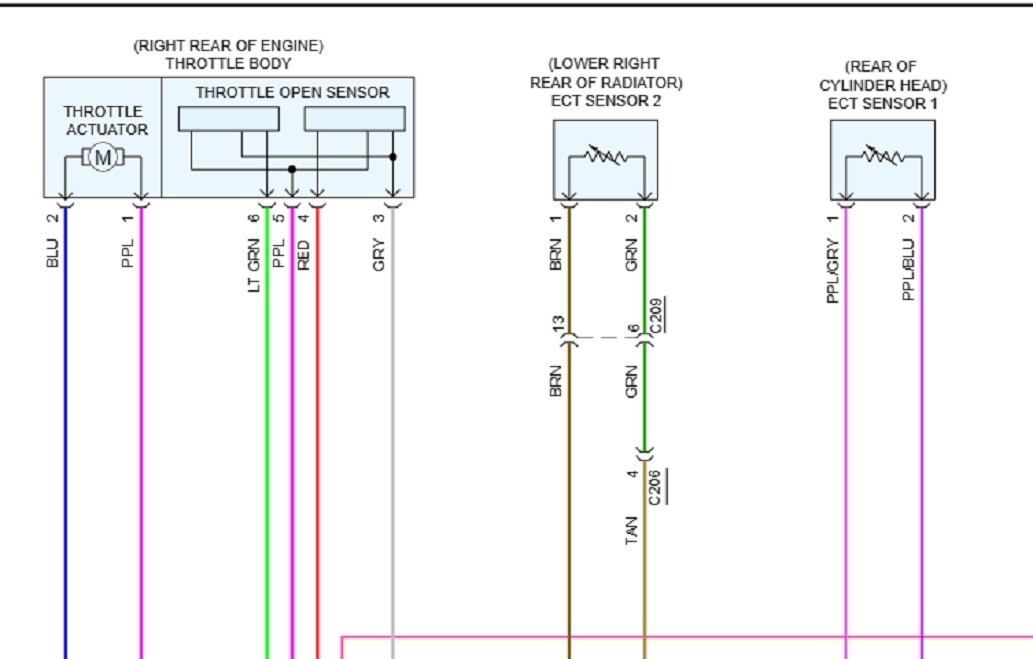
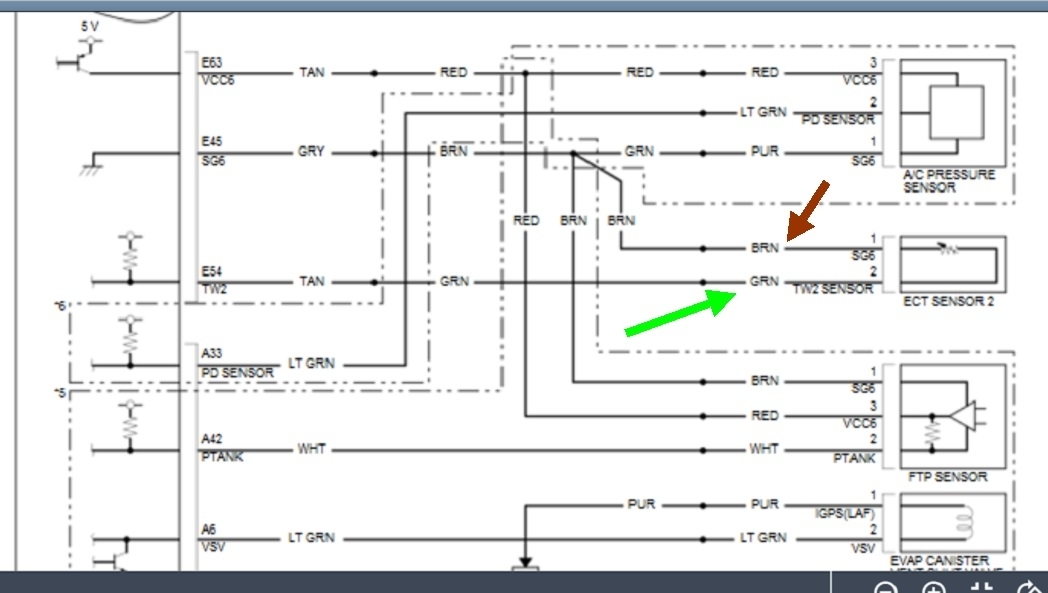
There's a couple of different ways of starting the diagnosis. This is a slightly less miserable diagram that shows this sensor's brown wire, (brown arrow), is tied in with other sensors, so it has to be a common ground wire. If the break was in that wire, there would be fault codes set for those other sensors too. Since there are not, we can assume that brown wire is okay, at least the part of it that applies to all those sensors.
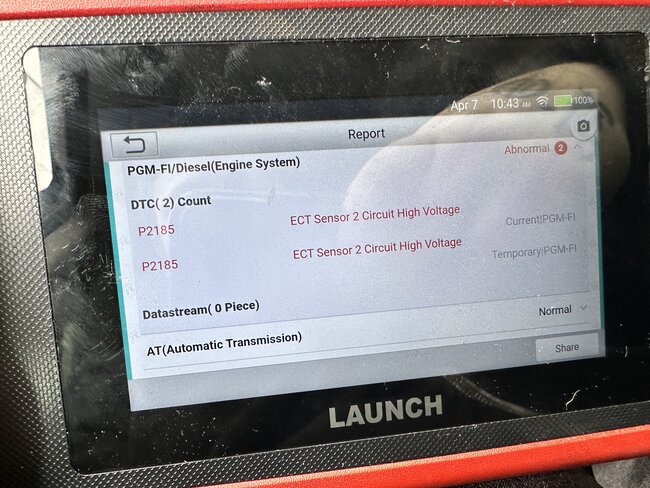
The diagram doesn't show how much voltage is applied to this sensor. That could be 12 volts or eight volts, but by far the most common is 5.0 volts. The sensor and its circuitry pull that 5.0 volts down to something less. Actual numbers can vary, but for training purposes, we use 0.5 to 4.5 volts as the acceptable range. If you were to short the green wire to ground, you'd get 0.0 volts which is outside that acceptable range. The computer would detect that and set a fault code for "Coolant temp sensor voltage too low". You have the exact opposite which will be set when there's a break in the green wire, that mating pair of connector terminals, inside the sensor itself, or in the brown wire up to the splice to the other sensor. You'd see 0.0 volts after that break, and 5.0 volts everywhere before it. The computer is included. It would see the 5.0 volts, which is also outside the acceptable range, and it would set code P2185, "CTS Voltage too high". (CTS and ECT are the same thing).
Where I would start is by unplugging that connector, then measuring the voltages on the two wires. Normally I would insist these are only valid when taken while that connector is plugged in, but in this case, I suspect you're going to find 0.0 volts. Ignition switch must be in "run". If you do find 0.0 volts, there's a break in that green wire.
If you find 5.0 volts on the green wire, check it again with that connector plugged in. Use a stretched-out paper clip pushed in alongside the green wire, through the rubber weather seal around it. Now, with it plugged in, you should find roughly 4.0 volts with a cold engine. If you still find 5.0 volts, there's a break after that point. Do the same check on the brown wire. Rather than typing for all the possibilities, let me know what you find up to this point. Are you comfortable using a digital voltmeter and an ohm meter? If you are not, I'll help with that. If you don't have one, you can find a perfectly fine meter at Harbor Freight Tools for $7.00. Also look at Walmart or any hardware store.
The vehicle should be okay to drive, especially at highway speeds where natural air flow keeps the radiator cool. If you do a lot of city driving, keep an eye on the "Temperature" gauge, and watch that it stays in the range you usually see it at.
Apr 9, 2023 at 12:35 PM