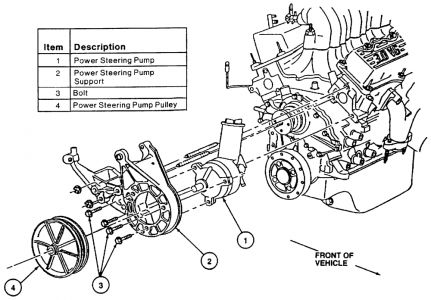
The power steering pump pulley must be removed prior to removal of the power steering pump.
REMOVAL:
Disconnect the negative battery cable.
Remove the accessory drive belts.
Remove the alternator.
Remove the accessory drive belt tensioner.
Remove the power steering pump pulley using a Steering Pump Pulley Remover (T69L-10300-B) or equivalent.
Position a drain pan under the power steering pump.
Disconnect the power steering pump pressure and return hoses.
Remove the power steering pump retaining bolts (three in the front, one in the rear) and remove the pump from the support.
Remove the pump support from the pump.
INSTALLATION:
Install the pump support on the pump and tighten the fasteners to 30-40 ft. lbs. (40-55 Nm).
Install the pump and tighten the retaining bolts to 30-40 ft. lbs. (40-55 Nm).
Connect the power steering pump pressure and return hoses.
Install the power steering pump pulley using a Steering Pump Pulley Installer (T65P-3A733-C) or equivalent.
Install the accessory drive belt tensioner.
Install the alternator.
Install the accessory drive belts.
Connect the negative battery cable.
Fill the power steering reservoir with premium power steering fluid to the COLD FILL line on the dipstick.
BLEEDING THE SYSTEM:
Ensure that the reservoir is full of Premium Power Steering Fluid (E6AZ-19582-AA) or equivalent.
Raise and safely support the front wheels of the vehicle.
Start the engine.
Turn the steering wheel slowly from lock-to-lock to expel air trapped in the system. Continue to turn the steering wheel until no more air bubbles are visible in the reservoir.
Confirm that the oil is not milky and that the fluid level is correct.
NOTE: An abrupt rise in the fluid level after stopping the engine is a sign of incomplete bleeding. If this occurs, repeat the bleeding procedure.
Nov 11, 2008 at 2:07 PM