Good evening.
Yes, it sounds like a restriction. It may be the condenser and the back up causes the high side pressure to rise.
The low side is too low. It should be 25-30 lbs and rock solid.
The high side should be two times outside temp plus 15%.
If your air flow is good through the radiator then I would suspect the condenser. I would go with condenser, receiver/dryer and an expansion valve.
Roy
https://www.2carpros.com/articles/car-air-conditioner-not-working-or-is-weak
https://www.2carpros.com/articles/re-charge-an-air-conditioner-system
WARNING: Refer to the applicable warnings and cautions for this system before performing the following operation See: Heating and Air Conditioning > Vehicle Damage Warnings > Warning and See: Heating and Air Conditioning > Vehicle Damage Warnings > Caution . Failure to follow these instructions may result in possible serious or fatal injury.
CAUTION: Before removing the A/C condenser, note the location of each of the radiator/condenser air seals. These air seals are used to direct air through the A/C condenser and radiator. The air seals must be reinstalled in their proper locations in order for the A/C and engine cooling systems to perform as designed.
NOTE: LHD model shown in illustrations. RHD model similar.
imageZoom/Print
1. Disconnect and isolate the negative battery cable.
2. Recover the refrigerant from the refrigerant system See: Heating and Air Conditioning > Procedures > Refrigerant System Recovery.
3. Remove the engine air cleaner housing.
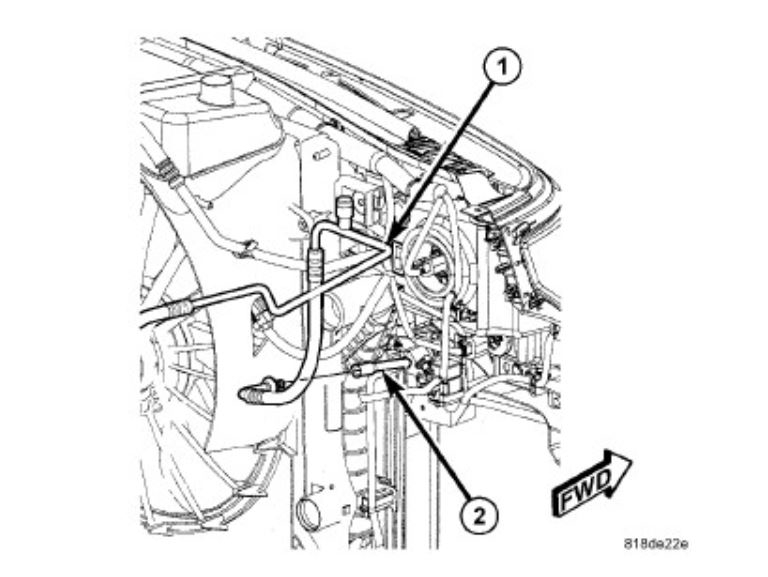
4. Remove the secondary retaining clip and using the proper A/C line disconnect tool (Special Tool Kit or equivalent), disconnect the A/C liquid line (1) from the condenser tube (2) See: Coupler HVAC > Removal and Replacement > Refrigerant Line Coupler - Removal.
imageZoom/Print
NOTE: Upper condenser retaining bracket and bolt shown. Lower retaining bracket and bolt similar.
5. Remove the grille See: Grille > Removal and Replacement > Grille - Removal.
6. If equipped with an automatic transmission, disconnect the transmission cooler lines from the transmission cooler portion of the A/C condenserSee: Transmission Cooler, A/T > Removal and Replacement > Removal.
7. Position the right side condenser air seal out of the way to gain access to the discharge line fitting and the lower condenser retaining bolt.
NOTE: Rotate and tilt the A/C discharge line as necessary to disconnect it from the A/C condenser.
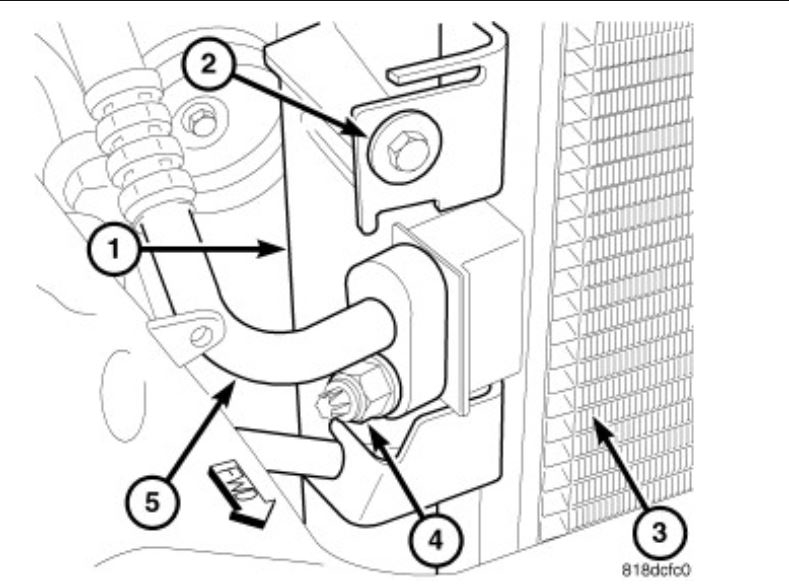
8. Remove the nut (4) that secures the A/C discharge line (5) to the A/C condenser (3) and disconnect the discharge line.
9. Remove the two bolts (2) that secure the A/C condenser to the right side of the radiator (1).
10. Carefully lift the A/C condenser straight up to disengage the condenser mounting brackets from the radiator and remove the condenser from the vehicle.
11. If required, remove the A/C receiver/drier from the A/C condenser See: Receiver Dryer > Removal and Replacement > A/C Receiver Drier - Removal.
12. Remove and discard the O-ring seals and gasket and install plugs in, or tape over the opened refrigerant line fittings and the condenser and receiver/drier ports.
expansion valve
REMOVAL
WARNING: Refer to the applicable warnings and cautions for this system before performing the following operation See: Heating and Air Conditioning > Vehicle Damage Warnings > Warning and See: Heating and Air Conditioning > Vehicle Damage Warnings > Caution . Failure to follow these instructions may result in possible serious or fatal injury.
NOTE: LHD model shown in illustrations. RHD model similar.
imageZoom/Print
1. Recover the refrigerant from the refrigerant systemSee: Heating and Air Conditioning > Procedures > Refrigerant System Recovery.
2. Disconnect and isolate the negative battery cable.
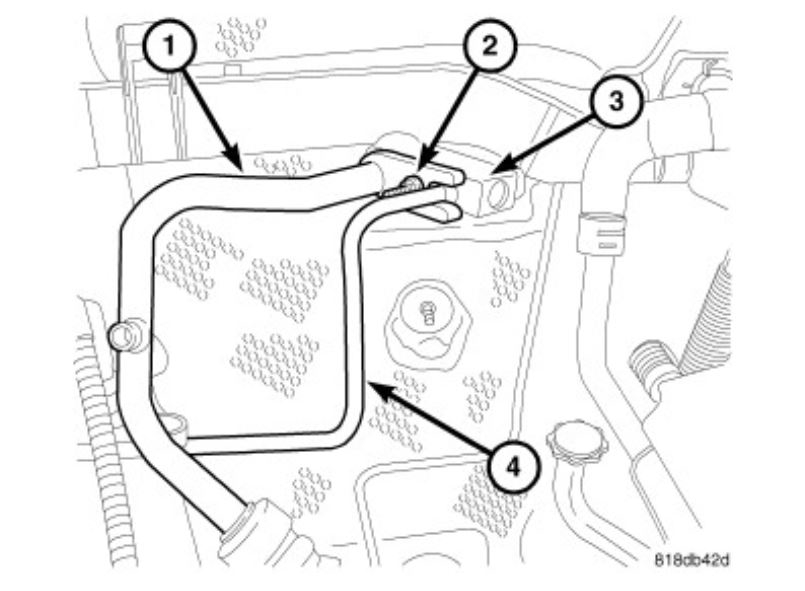
3. Remove the nut (2) that secures the A/C suction line (1) and the A/C liquid line (4) to the A/C expansion valve (3).
4. Disconnect the A/C suction and liquid lines from the A/C expansion valve, remove and discard the O-ring seals and position the refrigerant lines out of the way.
imageZoom/Print
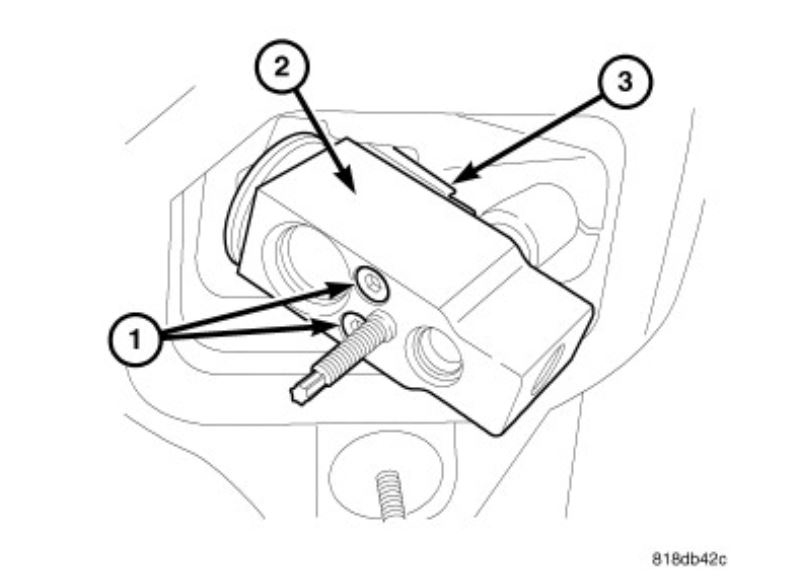
5. Remove the two bolts (1) that secure the A/C expansion valve (2) to the evaporator tube tapping block (3).
6. Remove the A/C expansion valve from the evaporator tube tapping block and remove and discard the O-ring seals.
7. Install plugs in, or tape over the opened refrigerant line and evaporator tube fittings and all expansion valve ports.
Images (Click to enlarge)
Jun 7, 2018 at 9:40 AM