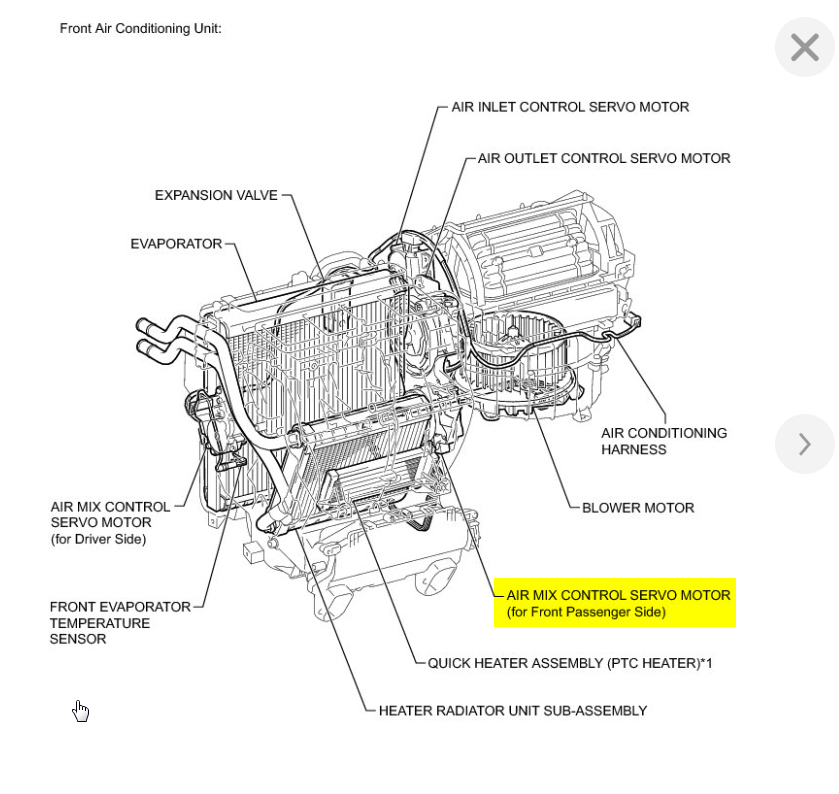
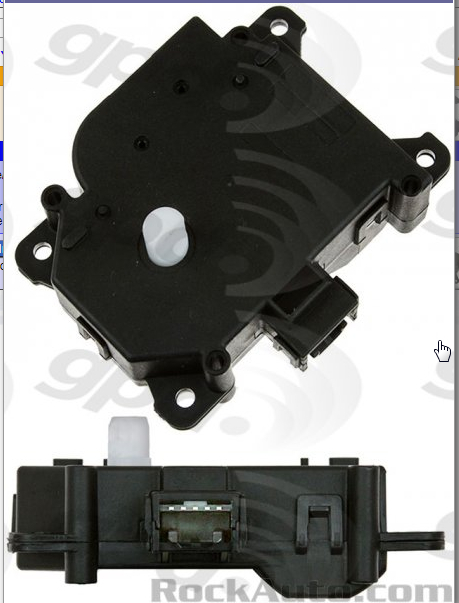
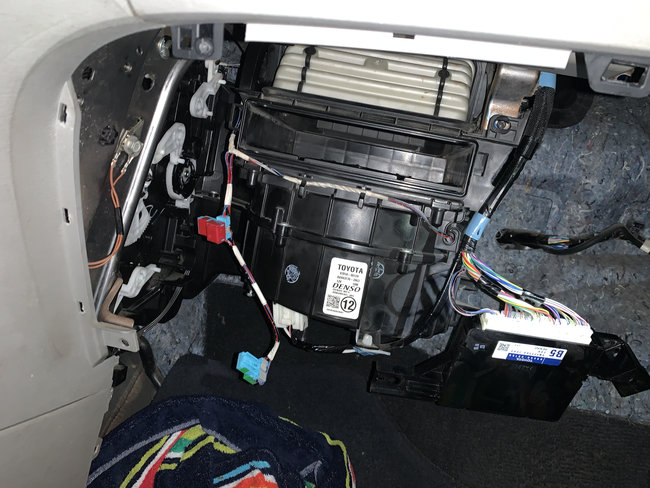
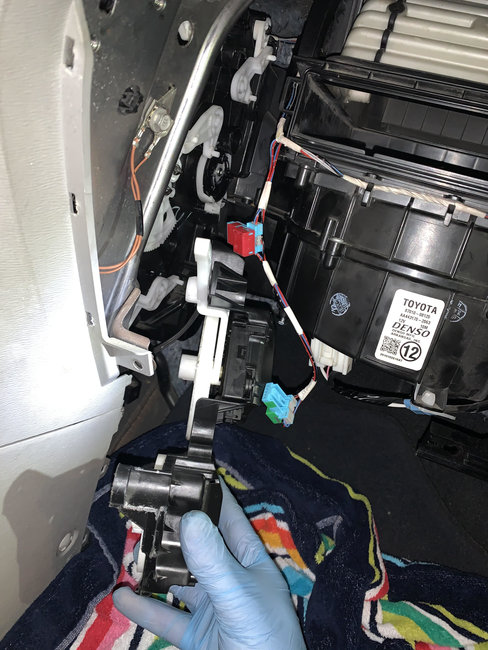
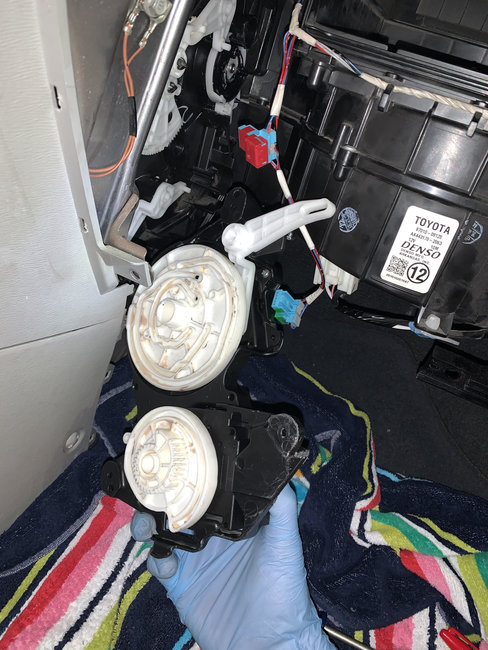
Thanks KASEKENNY1. I got it back together and everything is working as it should. I took the top wheel off the assembly and seated it first, then put in the assembly, seating the shaft from the top actuator into the wheel. This approach had two advantages. First, it gave me the extra space I needed to get the assembly in the right position. Second, it let me easily get the wheel aligned with the levers so they were seated and could be tested to avoid a misalignment that would likely result in something breaking when the actuator turned under power. So it turns out, it is possible to replace these actuators without a total disassembly of the dashboard (way beyond my at-home repair comfort level) or a huge bill from the dealer. $37 part from RockAuto and a bit of my time spread over a few days. With what I know now, I think I could do this start to finish in a few hours. Let me try to summarize for anyone else trying to do this...
1. With car on, set temperature to Max Cold, Recirculate to the On position, and the Mode setting to face vents (no feet or defrost). This step and step 2 will make it easier to remove and re-install the actuator assembly.
2. Press the defrost button. This is a dedicated button that is separate from and overrides the Mode setting.
3. Turn the car off and disconnect the battery - this will keep the actuators from moving further and is recommended for safety with the airbag system.
4. Remove the lower glove box door, the trim panel behind it, and the trim panel on the lower left of the passenger foot well. The glove box comes out by just pinching the sides inward and disconnecting the damper on the right side (simple, you can find videos online)
5. Remove the foot vent duct (no screws, just some clips).
6. Unclip the two harness plugs to the top and lower actuators.
7. Remove the three screws that attach the actuators assembly. The top screw is accessible through the recirculation assembly provided you have set the recirculation to On which rotates the recirculation door back toward the engine and out of the way.
8. Remove the assembly. Push it away from mount (same direction the screws came out) to unseat the two shafts then wiggle it out. There is no real trick other than trial and error. The gears and levers are pliable plastic so unless you really force something, you are unlikely to break anything. I ended up just jiggling it vigorously until it came loose enough to remove.
9. With the actuators assembly out, it is a simple process to replace either or both actuators. They are attached with a few screws and plastic clips.
10. Reattach the harness wires to the still removed assembly. Reconnect the battery and turn the car back on. Confirm the system is still at the settings from steps one and two. This will ensure that the new actuator rotates to the correct position for reassembly.
11. Turn off car. Disconnect the battery. Disconnect the harness clips again.
11. Set the levers under the dash manually as follows working from the bottom up.
* The bottom lever is gravity set, meaning it always falls to a given position and you don't need to fuss with it.
* The next lever, a geared semi-circle should be set toward the passenger cabin.
* The next lever is a black wheel with a two black nubs. It only turns a quarter turn or so in either direction. Push the top nub toward the engine to turn the the wheel clockwise until it stops.
* The next lever is for the feet vent door. Push it toward the engine to close the feet vent door. You can visually confirm the door is closed -- it is located where the foot vent duct was removed.
* The top front and top back actuators can be left in their gravity settings.
12. Remove the white plastic wheel from the top actuator. Its just a clip on the shaft that releases it.
13. Seat the wheel in the shaft hole. This is a little tricky and will take some trial and error and perhaps a bit of study of the grooves. When you have it in correctly, you will feel it snap in and be able to rotate it toward the engine (clockwise) almost a full turn and see the levers move. If it isn't in correctly, it will turn only a little and bind. If this happens, check all the lever settings are in the positions from step 11 and try again. Remember, the wheel has to be in the correct position for the semicircle shaft of the actuator to seat -- I used a sharpie to mark the alignment when it clicked in so I could rotate test, but still come back to the correct starting position.
14. While keeping a bit of pressure to the whee so it doesn't unseat from the levers, slide the actuator back into position. This is another tricky part because if the wheel moves too much, it will no longer be connected properly to the lever arms which will likely cause something to break when the actuator turns under power. I had someone else with small hands hold the wheel in so I could use two hands to get the assembly back in. This takes some patience and a bit of maneuvering and wiggling, but the shaft should seat in the wheel and the arm for top front lever should also seat and connect.
15. Secure the actuators assembly with the three mounting screws removed in step 7.
16. Reattach the harness plugs and reconnect the battery.
17. Turn on the car and observe the actuators assembly and lever arms. Check that everything is working as expected by changing the temperature to Max Hot and Max Cold (bottom actuator) and cycling the Mode settings (top actuator). Mine all worked under power, but I was ready to turn the car off if I heard things binding.
18. Replace foot vent duck, trim pieces, and glove box.
Hope this helps.
Dec 22, 2019 at 12:26 PM