REMOVAL PROCEDURE
CAUTION: Fuel Vapors can collect while servicing fuel system parts in enclosed areas such as a trunk. To reduce the risk of fire and increased exposure to vapors:
Use forced air ventilation such as a fan set outside of the trunk.
Plug or cap any fuel system openings in order to reduce fuel vapor formation.
Clean up any spilled fuel immediately.
Avoid sparks and any source of ignition.
Use signs to alert others in the work area that fuel system work is in process.
NOTE: Clean all of the following areas before performing any disconnections in order to avoid possible contamination in the system:
The fuel pipe connections
The hose connections
The areas surrounding the connections
IMPORTANT:
For rear compartment (trunk) accessible fuel sender assemblies, completely remove the rear compartment carpet before removing the fuel sender access panel.
Always replace the fuel sender O-rings when reinstalling the fuel sender assembly.
The modular fuel sender assembly will spring-up when the snap ring is removed.
Always maintain cleanliness when servicing fuel system components.
Relieve the fuel system fuel pressure. Refer to Fuel Pressure Relief Procedure. See: Fuel Pressure Release\Service and Repair
Remove the rear compartment trim panel.
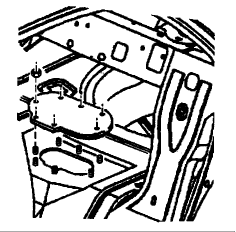
Remove the retaining nuts from the fuel sender access panel.
Remove the fuel sender access panel.
Disconnect the fuel tank pressure sensor electrical connector.
Disconnect the fuel sender electrical connector.
Clean the fuel pipes, and fuel sender assembly to prevent possible fuel contamination during removal.
Disconnect the quick-connect fittings at the fuel sender assembly.
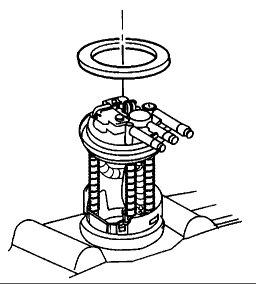
Remove the fuel sender retaining snap ring.
Remove the modular fuel sender assembly.
Clean the fuel sender assembly O-ring sealing surfaces.
Inspect the fuel sender assembly O-ring sealing surfaces.
INSTALLATION PROCEDURE
NOTE: Always re-attach the fuel lines and fuel filter with all original type fasteners and hardware.
Do not repair sections of fuel pipes.
IMPORTANT:
Care should be taken not to fold over or twist the fuel pump strainer when installing the fuel sender assembly, as this will restrict fuel flow. Also, assure that the fuel pump strainer does not block full travel of float arm.
Be sure that the fuel sender assembly retaining snap ring is fully seated within the tab slots on the fuel tank.
Position the new fuel sender assembly O-ring on the fuel tank.
Reinstall the fuel sender assembly into the fuel tank.
Reinstall the fuel sender assembly retaining snap ring.
Connect the fuel sender electrical connector.
Connect the fuel tank pressure sensor electrical connector.
Connect the quick-connect fittings at the fuel sender assembly.
Reconnect the negative battery cable.
Tighten the fuel filler cap.
Inspect for leaks.
9.1. Turn the ignition ON for 2 seconds.
9.2. Turn the ignition OFF for 10 seconds.
9.3. Turn the ignition ON.
9.4. Check for fuel leaks.
Install the fuel sender access panel. NOTE: Refer to Fastener Notice in Service Precautions.
Install the fuel sender access panel retaining nuts. Tighten Tighten the fuel sender access panel nuts to 10 N.m (8 lb ft)
Install the rear compartment trim panel.
Install fuel injection sight shield.
Nov 14, 2009 at 9:06 AM