1992 PLYMOUTH VOYAGER
Avatar
JOEY FITZGERALD
  • MEMBER
  • 32 POSTS
I have 92 ply voyager turns over fine.no spark at coil.don't have momentary 12v or 12v at start.
Oct 27, 2012 at 10:33 PM
Advertisement
Avatar
CARADIODOC
  • CERTIFIED EXPERT
  • 34,308 POSTS
Do you mean no 12 volts at the ignition coil or injectors during cranking or for the first one second after turning on the ignition switch? If that is correct, swap the automatic shutdown (ASD) relay with another relay like it such as the AC compressor relay, then see if you get voltage on that circuit. If not, remove the relay and check for voltage on terminal 30 or 87. Sorry, I can't remember which one but one of them must have 12 volts all the time. If neither has it, a fuse is blown. If you do find it, feel if it is clicking when a helper turns on the ignition switch.
Oct 27, 2012 at 11:10 PM
Avatar
JOEY FITZGERALD
  • MEMBER
  • 32 POSTS
I have tried recently to get an answer ,I tried go back to an older question that was asked a couple of days ago.and I don't know if I should repost the whole thing or tryy to get an answer modified?
Oct 28, 2012 at 9:35 AM
Advertisement
Avatar
JOEY FITZGERALD
  • MEMBER
  • 32 POSTS
I had already swapped the asd relay and no luck but did not check for volts.I'll give it a try and let you guys know.I also checked the fuses, @fusible links .they all checked out ok.I was curious once the ecm gets all it's info ,does it then and allow the asd to operate?I guess what I'm asking what power source feeds the asd, and ecm? What pin #on the ecm receives 12v? Or how much volts should present? And on more than one pin ,thanks guys
Oct 28, 2012 at 9:58 AM
Avatar
JOEY FITZGERALD
  • MEMBER
  • 32 POSTS
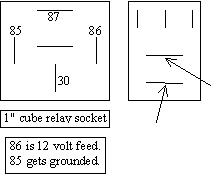
On the asd relay,#30 has 12v,#86 has 12v/w key in run poss.,#87 out To inj.@coil.#85 should be grnd? Right? using a conuity tester I don't have any.if I use a jumper to neg batt the asd works.how and where does #85 get it's grnd?
Oct 28, 2012 at 3:20 PM
Avatar
JOEY FITZGERALD
  • MEMBER
  • 32 POSTS
I think I found it, pin #51 on the ecm.so I guess that there might be a problem with the ecm.
Oct 28, 2012 at 3:45 PM
Avatar
CARADIODOC
  • CERTIFIED EXPERT
  • 34,308 POSTS
The web site changed last week to a new format and the site host is having a huge problem with sending out automated e-mails letting you and me know when a reply is posted. What I've been doing is right-clicking then opening each new question I read in a new tab, then I leave those tabs open so I can refresh them later to see if a reply was posted. Unfortunately I have well over 100 tabs open and it has slowed my really old computer to a crawl. If it went any slower it would be going backward! It is common to take 5 - 10 minutes to switch to a new page.

Don't start a new question as that will just make it worse. I started getting a few automated e-mails this afternoon. I noticed both of yours came through. On the site they are listed as you replied last night, but I just got the message at 1:12 p.m. today. Hopefully this will be fixed soon, then I may get flooded with hundreds of replies to answer. Sleep is over-rated anyhow.

As for your ASD relay, the 12 volts on terminal 30 is correct. That is the feed for the switched current to the injectors, coil pack, fuel pump, alternator field, and oxygen sensor heater. The 12 volts from the ignition switch to terminal 86 is also correct. That feeds the coil inside the relay. Terminal 87 does indeed need to be grounded but that is done by the Engine Computer. You can't measure that circuit for continuity. All you can do is watch its operation for that first one-second blip when you turn on the ignition switch. The easiest way to do that is to monitor the voltage we've been talking about from relay terminal 87 which goes to the injector, coil, etc. The second way is to feel if the relay clicks on, then clicks off one second later when a helper turns the ignition switch on. The third way, which is more time-consuming, is to place the probe of your test light on terminal 85 while the relay is installed, AND since you're testing for a ground, you have to move the test light's ground clip to the battery positive post. This way the test light will light up at the same time the relay is energized.

If any of those methods proves the relay is turning on for one second, that proves the circuitry is good and the computer has control of the relay. If the switched 12 volts shows up on 87 it should also be showing up at the coil and injectors. If it's at 87 but nowhere else, there has to be a break in that wire or a corroded splice.

Once you verify the 12 volts is showing up at the coil and injectors for one second, the next thing is it has to reappear during engine rotation, (cranking or running). If it does not, the computer isn't grounding the ASD relay terminal 85 because it doesn't know the engine is rotating. That is because a signal is missing from the cam or crank sensor or both. A scanner that displays live data will show both of them as "no" or "present" during cranking so you know which one to diagnose. If one signal is missing, suspect the sensor, its air gap, or a break in its signal wire. If both signals are missing, suspect a break in the 5, 8, or 10 volt wire that feeds both of them, a break in their common ground return wire, or the feed wire is shorted to ground by a pinched wire or shorted sensor. That feed voltage should be present all the time the ignition switch is on. If you don't find it at either sensor, unplug them and measure on the plugs after turning the ignition switch off and back on. If the wire or either sensor grounded out that feed line, the computer shuts that power supply down to protect it. Once the short is removed, you have to cycle the ignition switch off and back on to reset it. Missing the supply voltage to the sensors is not very common so we'll address that later if it becomes necessary.

Just for information purposes, you need 12 volts from the ignition switch to relay terminal 86 AND the ground on 85 to energize the coil inside the ASD relay. That is a double safety circuit and is extremely reliable and effective. In a crash that ruptures a fuel line, the engine can't run without fuel pressure so it stalls. That means no pulses from those two sensors so the computer turns the ASD relay off. That removes the 12 volts going to the fuel pump, or, on some models it also turns off a separate fuel pump relay along with the ASD relay. Either way the pump stops dumping raw fuel onto the ground where it would be a fire hazard. That wire between the computer and terminal 85 is only a few inches long but if it somehow got pinched or someone tried to modify it, the relay would still get turned off by turning off the ignition switch.

Unfortunately there is no easy way to know if the pulses are being received by the computer except with a scanner.

If you do find steady voltage at the coil and injectors during cranking, that indicates you have a less-common problem with one of the three individual circuits, the ignition coil, injector circuit, or the fuel pump. Of the three a dead fuel pump is the most likely suspect. You won't hear it hum for that one second after turning on the ignition switch. The coil pack would be next. You would have no spark but you would have good fuel pressure and you'd smell the raw fuel. If all the injectors were dead, suspect a break in the common wire feeding them from the ASD relay. Failure of one driver circuit in the computer is rare, and a total failure of all four, six, eight, or ten is unheard of. More commonly that would be caused by a blown fuse feeding the computer.
Oct 29, 2012 at 9:49 PM
Avatar
JOEY FITZGERALD
  • MEMBER
  • 32 POSTS
Hi, and thanks for the info.I'm going to try to find the problem as you have suggested.sorry about the repeets, and sorry to here about the computer problems, and missed sleep too.I have only a couple of other questions,1 what fuse #feeds the computer.2 and which #s fuses feeds the cruise control, radio, overhead console? Thanks again for all your detailed help .I'm really glad your Web site is here, if I had either the techno or the resources to help I surly would.once again thanks and I'll try not to bug you so much. Joey
Oct 31, 2012 at 4:08 AM
Avatar
CARADIODOC
  • CERTIFIED EXPERT
  • 34,308 POSTS
There are multiple 12 volt feeds for every computer. Pin 9 is the 12 volts from the ignition switch "run" position. That circuit taps off and goes to fuse 14, a 2 amp, for the cruise control. That all comes off the ignition switch which is fed through an orange fuse link wire by the left strut tower. Pin 3 has 12 volts all the time. That circuit is tied in with the feed for the ASD relay, (16 gauge red / white wire). If that's missing, there's a 22 gauge white fuse link wire by the left strut tower. The other side of the ASD relay feeds the injectors and coil(s), and it goes to pin 57. That tells the computer it was successful in turning that relay on. Looks like those terminals are the same for all three engines.

Fuse 3, a 20 amp, feeds the power mirrors and radio memory circuit. That should be live all the time. If that fuse blows, suspect frayed wires between the driver's door hinges. Fuse 6, a 10 amp, is the switched 12 volts for the radio.

For the overhead unit it would be easier if you tell me what's not working. There's so many circuits feeding it for all the different lamps and rear vent windows that it's hard to follow. I see a 30 amp circuit breaker in cavity 25 but it just shows it going to a connector but it doesn't say for what.
Nov 1, 2012 at 9:35 AM
Avatar
JOEY FITZGERALD
  • MEMBER
  • 32 POSTS
Hi guys had to take a day off.On the overhead console question it doesn't have fuel economy info, or compass info
The lights work but that is it.I went to the junk yard and
pulled one off another van I also pulled the two sensors that are in front of the radiator.but I'm not sure what's what.I installed the new console and a body control module, to no avail.So I thought it might be fuse related.but also not sure which sensor too install or if that's it.Also the two rear window open/closers work.The answers give me a direction to head in now on getting it running.Also unrelated to the van I've a question on a 2003 dodge ram 1500 v6 3.7ltr? The Speedo does not start working untill you reach 35,40mph.how do I fix that? Also the brake@abs lights are on.the man said he installed new power booster ,master cyl, and pads.how do I reset the system, if that's what it is? also its unknown if, and when the Trans filter was changed 118456 mi.it should be of the ordinary.changed shouldn't it? It not slipping or doing anything out of the ordinary.once again thanks and I'll get that donation off in the next day or so. Joey
Nov 3, 2012 at 6:13 AM
Avatar
CARADIODOC
  • CERTIFIED EXPERT
  • 34,308 POSTS
If the display is dead, that would mean a 12 volt feed or a ground is missing, but I can't find anything that would cause that if the lights are working. The only switched circuit is the tan wire but that has to be okay because it's the feed for the power vent windows.

You can also look at the two data buss wires. Those are the violet / brown and white / black next to each other in the connector. Those aren't needed for the lights and vent window motors but they might be what tells the display to turn on. The data buss signals come from the Body Computer.

If you have dashes in the display, the unit is working but that indicates a problem with the sensor. That should only affect the outside thermometer though. If the sensor is unplugged, the display should say "OC" for "open circuit".

For the speedometer, look at the speed sensor in the tail housing of the transmission. Look for stretched terminals in the connector although that will usually cause intermittent operation at any speed, not at a specific speed all the time like you indicated. Look at the plastic gear on the end of the sensor, (if that's the design they're still using), to be sure no teeth are worn down. A more likely cause would be the sensor itself has a partially-shorted coil of wire inside and must be replaced. Signals generated this way are a result of the strength of a magnetic field, the size of the coil of wire the voltage is induced into, and the speed of movement between those two. If the coil of wire becomes smaller, as in when it's partially-shorted, you'll need more speed to overcome the weaker signal that is induced into it.

The red brake warning light is due to low brake fluid level in the reservoir, the parking brake pedal isn't fully released, or there was unequal pressures in the two hydraulic circuits. First pull up on the parking brake pedal. If the light goes out the cable is stretched, misadjusted, or more commonly a cable by either rear wheel is sticking partially-applied. The switch on the parking brake pedal could be damaged too. Don't waste your time trying to bend them straight. Find a good used one in the salvage yard.

Unplug the level sensor on the side of the master cylinder reservoir. If the light goes out and the fluid level is okay, the float has sunk or the switch is shorted. If the level is low there is either a leak that must be addressed, the front pads are worn, but you said they're new, or the fellow didn't fill the reservoir after bleeding the system.

Unplug the wire from the combination valve on the frame, under the master cylinder. If the light goes out, the valve has tripped from unequal pressures. That can happen during improper bleeding procedures or when a leak was in one of the systems. That valve is spring-loaded but it often gets stuck. Once the condition that caused the valve to trip is fixed, it is sometimes necessary to jar it loose with a few hard, quick jabs on the brake pedal.

Don't worry about the yellow ABS warning light yet until the red one is solved. It will be on because the ABS Computer can't guarantee proper operation when there's some other problem with the base brake system pressures. Once the red one is off, you'll have to turn the ignition switch off and back on to reset the yellow one. If the yellow one stays on by itself after the red one is off, a problem has been detected and reading the stored diagnostic fault code will get you into the circuit or system that needs further diagnosis.

The transmission fluid is typically supposed to be changed every 36,000 miles. Mine on my '88 Grand Caravan has been changed once in 237,000 miles, at around 90,000 miles, and I use it to regularly drag around a tandem axle enclosed trailer that's bigger than the van. That is no longer neglect. That's abuse, and I don't recommend that to anyone.
Nov 3, 2012 at 8:53 PM
Avatar
JOEY FITZGERALD
  • MEMBER
  • 32 POSTS
I was researching in the Hayes repair manual, about the Trans and couldn't find anything on the sensor or gear.I'll crawl under today tho see if I can locate it.if you can attach a pic of what it looks like would be appreciated.also I see for 2003-2008 Haynes manual they list a 4,5,6 speeds.mine is a four speed I would like too put in a six speed.is it possible with the 3.7? If so what all do I get from the salvage yard, computer, wiring, flex plate, more? And what motor and year? What identifying #s. Thank you Joey
Nov 4, 2012 at 2:37 PM
Avatar
CARADIODOC
  • CERTIFIED EXPERT
  • 34,308 POSTS
I messed up with that gear. I was thinking of a rear-wheel-drive van I had replied to earlier. With the 4-speed, you have an input speed sensor and an output speed sensor. The Transmission Computer calculates road speed by the programmed-in tire size and axle ratio. It sends that information to the Body Computer which interprets it and sends it to the instrument cluster.

Don't even think about switching to a different model transmission. We run into enough trouble with the same model from different years. The computers will be different among many other things. Beginning on various models in the early 2000s all car manufacturers switched to the new "CAN Buss" system. That's a different type of computer signal and is not at all compatible with older computers. The Transmission Computer is needed for the transmission it's designed for, then you'll need the newer Body Computer which tells all the other computers when to turn on. You'll need the newer versions of every single other computer including the instrument cluster, (which won't fit), Air Bag Computer, and Anti-lock Brake Computer if you have one. All the connectors will be different so you'll be cobbling all new wiring harnesses.

The mounts are going to be different too to match the newer body designs.
Nov 6, 2012 at 10:14 AM
Avatar
JOEY FITZGERALD
  • MEMBER
  • 32 POSTS
Ok I was hoping I could get a few mpg's by switching.well I guess that's a no go.any way how do I fix my Speedo prob, change input, output sensors? Computer?I finally got my check I'll transfer some through pay pal real soon. Joey
Nov 6, 2012 at 2:58 PM
Avatar
CARADIODOC
  • CERTIFIED EXPERT
  • 34,308 POSTS
There's two speed sensors on the four-speed transmission. If either one doesn't produce its signal, the Transmission Computer will default it to second gear. If your is shifting properly, the sensors are working. That means the Body Computer or the Transmission Computer aren't sending the speed information out on the "data buss". That's the pair of wires all the computers share information on. There could be a problem on the instrument cluster too but that's not real common.

You'll need a scanner to see what's going on. It will display the road speed the various computers are seeing. If that is correct, the problem is in the cluster. Most scanners can also run a gauge test. That will run them all up to 1/4, 1/2, 3/4, and full scale. That will show if the gauge is working.
Nov 7, 2012 at 6:56 AM
Avatar
JOEY FITZGERALD
  • MEMBER
  • 32 POSTS
It dawned on me with asking about the 6 speed.did you think I wanted to put it into the van?I was thinking about putting it a(6 speed automatic), from say some 2008 3.7 litr,6 speed auto, to replace the one in the 2003 3.7 litr,4 speed auto dodge 1500ram.I thought since the years and same motor were kind of close I would able to make the computers work together.
I know I originally started asking about my 92 plym voyager, and started asking questions on the 2003.I guess shouldn't have asked them in the same paragraph. Also on the 92 the two sensors in front of the radiator, is the upper one temp sensor for the overhead console or the lower one? And the lower one temp sensor for the cooling fan? And where does the (overhead con.) get its info on the compass, north, east,ect,ect, from? Thank you sorry I'm doing all my editing on my phone , my wife lives on the home computer and I have to sneek in whenever I can, or like this on my phone.Thanks Joey
Nov 7, 2012 at 6:56 AM
Avatar
CARADIODOC
  • CERTIFIED EXPERT
  • 34,308 POSTS
Can't help you with the newer cars and transmissions. I DID recently find out that you can replace the 2.7L in an early 2000s Intrepid with a 3.5L, and use the same transmission AND the same Engine Computer. One of the reasons I became a Chrysler fan in the 70s was they built in so much parts interchangeability among many models and years but I never would have believed two different engines would run perfectly on the same computer.

For your overhead unit, the sensor is inside it for the compass. It consists of some "Hall Effect" transistors which are controlled by a magnetic field instead of a small current flow like normal. Turning those transistors in the earth's magnetic field causes them to conduct more or less, then the computer circuit looks at which ones are conducting the most current to figure out how they're oriented.

The sensor for the thermometer sits on the middle of the brace in front of the radiator. It has two wires, and the sensing element on the other end is a round cylinder about 3/8" long and 1/4" in diameter. Because it sits so close to the radiator and would be affected by its heat, that reading will not update or change while the van is standing still. It needs road speed and air flow to be accurate.

I don't know what the second sensor is for. There is no separate sensor for the radiator fan. There are two coolant temperature sensors on the engine near the thermostat housing. One is for the dash gauge and will always have one wire, usually purple. If you unplug it the gauge will go to "cold". If you ground the wire, the gauge will read full "hot".

The coolant temperature sensor for the Engine Computer will always have two wires. If you unplug that one with the ignition switch turned on, the reading on a scanner would be -40 degrees, and the radiator fan will turn on because the computer knows that is not a valid reading and it doesn't know if the engine is overheating. Just in case, they turn on the fan. That will also turn on the Check Engine light and set a fault code in memory for "Coolant temperature sensor voltage too high". The fan will go off when you reconnect that sensor, and on some models the Check Engine light will go off. If the light stays on, it will be off the next time you start the engine. The fault code will erase by itself after 50 starts.

When the Engine Computer sees approximately 210 degrees from the coolant temperature sensor, it turns on the radiator fan relay. It turns it off at 198 degrees.
Nov 7, 2012 at 8:19 AM
Avatar
JOEY FITZGERALD
  • MEMBER
  • 32 POSTS
I took the truck to the AutoZone and they hooked up the meter to it, and didn't show any codes.since then a engine light with code p0455, by key on; off; on; off ; on, self diagnosis.but the funny thing about the Speedo (not working until I reach 35-40mph, going from 0 to 35-40 in one bouncing motion is if at around 25,30 you step on the brake pedal it goes up too whatever speed your doing.and you when you release the brake pedal, it quits working again.I don't know if this has anything to with what's happening, there's an extra 12v acc below the drink holder that has no power to it.the cig lighter works fine.maybe a missing power source? PS still have not been able to get the van. going yet.I'm not giving up yet though.or figure out the brake,abs lights either.thank you for all your guidance,I know with your knowledge and acess to info you'll be able to guide me to an answer.I know its hard to do some diagnostics without having access too the car right in front of you.it would be already fixed.thanks for everything. Joey
Nov 13, 2012 at 8:37 AM
Avatar
JOEY FITZGERALD
  • MEMBER
  • 32 POSTS
I looked up in you code diagnostics (P0455) is evaporative control issue (big leak), should I look for broken hose?, filter, what.should I crank up the truck and get under it and listen for a vacuum leak, or (hiss) pressure leaks?.a sensor not closing, opening?a fuse controlling a sensor? Thanks
Nov 13, 2012 at 9:24 AM
Avatar
CARADIODOC
  • CERTIFIED EXPERT
  • 34,308 POSTS
The evaporative emissions system including the gas tank is pumped up to 2 psi so you won't hear a leak. A big leak is generally the gas cap was left loose but also look for a hose disconnected between the tank and the charcoal canister.

When you can't find the cause visually, you need a smoke machine to inject a white non-toxic smoke into the system, then you look for where it sneaks out. You might find one at an auto parts store that rents or borrows tools.
Nov 13, 2012 at 9:33 AM
Avatar
JOEY FITZGERALD
  • MEMBER
  • 32 POSTS
Well hello again I feel like a big dummy.I found my P0455 code,I had crawled into the engine compartment to check and clean (sandblast) the plugs.and I guess my big old foot knocked the connection loose, on the solenoid that goes to evap system.Now I need to reset the error code, the auto parts store says that one they aren't aloud to reset the computer.state law or some gov thing.Will unplugging the batt, and waiting a few min, do the job? Also they told me that their tester doesn't read the problem (Speedo does not read correctly).I believe they want to sell me a tester .but if it's the same one ,why doesn't there's work! Any suggestionsas what to do, I can't afford to put it in the shop, just to get a reading.@still can't get the brake-abs lights to go away either tried all your suggestions .I'll try rebleeding the system .got any other ideas how to fix my problems? Thank you for all your help happy holidays Joey
Nov 19, 2012 at 9:50 AM
Avatar
JOEY FITZGERALD
  • MEMBER
  • 32 POSTS
Also if I do any welding on the truck should I disconnect , both leads on the Batt? Thanks
Nov 19, 2012 at 10:08 AM
Avatar
CARADIODOC
  • CERTIFIED EXPERT
  • 34,308 POSTS
What you need is a regular scanner that will access all of the computers. Most auto parts stores that read codes for you for free are using simple code readers. Code readers take two minutes to learn how to use. To learn the original Chrysler DRB3 I attended a two-day-long class. Comparing a code reader to a scanner is like comparing a computer mouse to the entire computer system. It doesn't do much.

The code readers I've seen only access the Engine Computer. They will not read Anti-lock Brake computer codes, Transmission Computer codes, Air Bag Computers, and things like that. I haven't heard of a government law that says you can't erase certain emissions codes. That would not make sense, but then again, politicians don't have any common sense. In fact, every problem they say we have and only they can fix was caused by the laws they passed previously. You NEED to be able to erase a code so if it comes back you'll know the problem is not fixed. You also need to know when a new problem is detected, and many self-tests won't run and many new problems won't be detected when certain other codes are already in memory.

In the past engine codes always erased by disconnecting the battery. That also erased fuel-trim data but those tables got rebuilt without you even noticing once you started driving it again. The codes in some ABS Computers could not be erased without a scanner. They would still be there when you reconnected the battery. Engine codes also used to erase automatically after 50 engine starts if the problem didn't act up again. I don't know if that's the case with a 2003 model but I have no reason to think it's different.

When they said their tester doesn't "read the problem", it sounds like what they're referring to is that difference between a scanner and a code reader. The code reader just shows the code number for the reason the Engine Computer is not happy. A scanner will show the information the computer is receiving to make those decisions to set codes and that it uses to adjust the fuel / air mixture and spark timing. You will see pages of sensor values and the information those values represent. It will show which switches are on and off, which relays it has turned on and off, and scanners are "bidirectional", meaning you can control stuff from its keyboard. You can operate the radiator fan and emissions solenoid circuits to allow you to take voltage readings and do other troubleshooting.

The scanner will display the speed sensor readings in real time. If you see one staying on "0", you'll know which circuit to diagnose.

As for welding on the vehicle, there's two schools of thought. The reason most people say to disconnect the battery is so there's no 12 volts feeding the computer memory circuits. Even with the ignition switch off, there's a small amount of circuitry still active in the computers. The radio is an easy-to-understand example. It maintains the clock time and the station presets with the ignition switch off. The thinking is those circuits will be dead so any voltage spikes that are magnetically "induced" into the wiring will not enter the computers and cause damage.

From my extensive tv / vcr repair background, I find the logic hard to agree with. Those voltage spikes that might be created are going to enter the computers on some sensor wires anyway, and that's where they could theoretically cause damage. With the memory circuits still powered up, those circuits could start to act on those spikes as though they were signals coming in from the various sensors. The problem with that theory is those circuits are able to filter out those spikes and ignore them when the computers are operating. They're even more able to block those voltage spikes when they're turned off.

The other problem I have is that the battery is so extremely huge electrically compared to those little voltage spikes that it holds the voltage steady at 12 volts and absorbs those spikes. With the battery disconnected there's nothing to hold the voltage to safe level. You have to first understand the two important laws of physics that makes an alternator work. 1) When you pass an electrical current through a wire, that sets up a magnetic field around it. 2) When you move a wire through a magnetic field, that field "induces" or CAUSES a current to want to flow in it. For the first one, the field strength is weak but if you coil that wire up, each loop adds to the strength. Remember making an electromagnet in science class with a nail, wire, and battery, and picking up paper clips with it? That's the first half of an alternator.

When you weld on the car, current is flowing between the electrode and ground clamp. Wherever it flows, a magnetic field is created. If that's through part of the frame rail and there's a wire harness laying alongside it, that magnetic field will induce a voltage into those wires. If those wires go to a tail light bulb, the voltage induced is not nearly strong enough to cause the bulbs to light up. If those wires are for a computer sensor, it is very unlikely the voltage induced will be anywhere near as high as the signal voltages those sensors normally produce. The parts of the computers that act on those sensor voltages are not functioning when the ignition switch is turned off so what difference does it make if a small voltage spike shows up there?

The voltage spikes are going to be created whether the battery is disconnected or not. For the people who think a computer is going to be damaged, the only way to isolate it from those spikes is to unplug every computer on the vehicle, and by the late '90s, that could be dozens of computer modules. I've never heard of anyone doing that.
Nov 19, 2012 at 7:39 PM
Avatar
JOEY FITZGERALD
  • MEMBER
  • 32 POSTS
If I decided to buy a scanner, where should I get one from? And how much should they cost.will I be able use it on obd 1cars? Or do you have to buy separate leads?
Nov 22, 2012 at 3:14 AM
Avatar
CARADIODOC
  • CERTIFIED EXPERT
  • 34,308 POSTS
I have the Chrysler DRB3 because all I will ever own are older Chryslers. Because it's a newer version, it only works back to 1998 models by itself. With a small plug-in card it will work back to '94 models and it will do OBD2 emissions-related diagnostics on all car brands sold in the U.S. I have another card that lets it work on '83 - '93 Chryslers. I bought this as a set through the dealer I used to work for. You can find them on eBay and you can buy them directly from the manufacturer but at a much higher cost. The cost is prohibitive for you though because for what you would spend, you can pay your mechanic to diagnose a lot of problems.

I also have the older Chrysler DRB2 but that only works on '95 and older models. You can find those very reasonably-priced on eBay. I have a Monitor 4000 which is very similar to the DRB2 and is made by the same manufacturer. The aftermarket scanners never do quite as much as the manufacturer's stuff, but in this case, I can work on Chryslers, GMs, and Fords with one cartridge. Another cartridge is strictly for the Chrysler A604 automatic transmission, and I have another one for anti-lock brakes, but I've never used it yet.

Snapon makes a number of very nice scanners but they are extremely proud of their products and charge accordingly for them. A lot of people have the Genesis and like it but I've only used one a little and I'm not that familiar with it.

If you do a search for "automotive scanner" on eBay, you'll see all kinds listed, and you'll learn a lot about them from reading the descriptions. The disadvantage to my DRB3 and the Genesis, and others is they have to be updated periodically. That isn't necessary for personal use but mine was just done by a former student who works at another dealership. The disadvantage of the older scanners, at least as far as shops are concerned, is you have to buy new cartridges all the time. With my Monitor 4000, I bought used cartridges that were two to four years old from the guys on the tool trucks. They traded them in from guys who wanted the very latest ones.

One of those that needs new cartridges all the time is the Snapon MT2500. We call that one the "red brick" because that's what it looks like. I used that one a lot at school but I never liked it after becoming familiar with the DRB3. I'm sure you'll find a lot of those on eBay real cheap along with lots of cartridges. They were around since the '90s and most mechanics have upgraded to something newer. They use two cartridges at once. One of them will walk you through troubleshooting steps with wire colors and test points, I'm told. I never let my students rely on that. I taught them to understand how the circuits work and how to read wiring diagrams.

You can also find a lot of simple code readers on eBay. Personally I wouldn't waste my money on them. They work perfectly fine, but Chrysler makes reading codes so much easier than any other manufacturer. The readers won't tell you anything you can't learn from cycling the ignition switch and reading the code numbers from the service manual.

As for cost, you'll be able to judge that better after looking at a lot of eBay listings. My DRB3 kit listed for around $6500.00 about five years ago but since they still like me at my former dealership, and I fix a lot of radios for them, they charged me less than $4000.00. Twelve years ago when I bought one for my Automotive program, the three "Super Cards" that let it work on older and other models cost around $440.00 each. I haven't looked at those on eBay in a long time but they had used ones all the time for less than half the cost of new ones. My DRB3 kit included six cables to cover all Chrysler products, but you still have to buy the Super Card for some cars. The replacement OBD2 cable costs over $100.00 but you can find new ones on eBay for less than 20 bucks.

I just did a search for the MT2500 on eBay, and found them from $285.00 to $800.00 with a big variety of included cables and cartridges. Also consider watching for auctions when a local car dealer or repair shop goes out of business. The problem there is you'll be bidding against other people who know what the stuff is worth to a business so you'll likely end up paying more than necessary.

Did a search for the DRB3 too but they're still in high demand and bringing high prices.
Nov 22, 2012 at 4:22 AM
Avatar
JOEY FITZGERALD
  • MEMBER
  • 32 POSTS
Ouch I never thought they would would cost so much, but after you explained all that it can do I can see why.I remember back in auto shop the big sun machines costing that much.funny though as big as it was and what it could do, the new one as small and portable as it is, can't even compare the two.isn't technology grand.I'd hoped it would have been affordable.to take care of the 03 ram and my 92 as well.I'd hoped to erase those codes, as well as a diagnostic tool.alas it's not to ment to be.well enough of your time, thank you for your help.hope you and yours have a happy Thanksgiving,Joey
Nov 22, 2012 at 8:39 AM
Avatar
JOEY FITZGERALD
  • MEMBER
  • 32 POSTS
Is the body control module for the gauges located under ashtray ? And I see several different places on the Trans that has wires that look like sensors.which one is the input and which one ifs the output?
Nov 24, 2012 at 4:23 AM
Avatar
CARADIODOC
  • CERTIFIED EXPERT
  • 34,308 POSTS
To get to the Body Computer, you have to remove the "knee blocker". That's the panel under the steering column. The parking brake release linkage is hooked to the handle. That does not have to be disconnected.

When the panel is off, you'll see the connectors for the computer at the far right side of the opening. There's one or two screws to remove, then it slides to the left to remove it.

The input speed sensor is nearest the engine. It reads the rotational speed of the torque converter. The output speed sensor reads the rotational speed of the ring gear in the differential so it will be further to the driver's side. It's on the front, halfway between the shift lever and the side cover.
Nov 24, 2012 at 5:38 AM
Avatar
JOEY FITZGERALD
  • MEMBER
  • 32 POSTS
Hello again,I have a question pertaining to the 03 truck.on the dash there are the speaker holes (three) what size after market speakers will fit.and what sizes are the ones in the door, and door pillar? And do the factory harnesses come with all the speaker wires in the harness? And lastly since the harness has the male end how can I get or make a female end to connect so I don't have to butcher the factory one?
Once again thank you for all your help, and I wish I had a chance to attend your classes.I could have learned do much more. Joey
Nov 30, 2012 at 11:17 AM
Avatar
CARADIODOC
  • CERTIFIED EXPERT
  • 34,308 POSTS
Can't be of much help with speaker sizes because I always stuck with factory original stuff. I just shipped out two with a radio yesterday that I repaired. They were the front speakers for a 2000 Caravan and they fit perfectly in my much older '88 Grand Caravan to test-run them.

You won't find any aftermarket speakers that will bolt right in. The diameters and the number and spacing of the screw holes will be a lot different. If I understand correctly, you are looking for a plug that will let you connect different speakers to the factory connectors. If that's right, head to a salvage yard and snip some off the speakers. The ones I just sent out had two-wire connectors that could be slid off by pressing down a little lock tab. The wires were only an inch long but that would be enough to solder to the new speakers. Use some RTV gasket sealer to glue anything that could vibrate and cause an irritating noise.

For a real nice upgrade, look for a similar vehicle with the Infinity system. I'm not sure if they still offered it in on '03. My '88 has it. They used little amplifiers on the speakers, and they had four-wire connectors. A lot of the newer models used a remote amplifier, and the speakers were the normal two-wire type. The extra two wires are for the 12 volt feed and ground wires for the amplifiers.

The nice thing about Chrysler radios is they all run speakers directly so they all interchange. When Fords or GMs have a remote amp, those are needed with those radios, otherwise there won't be enough volume. Chrysler amps do not increase volume or power. They only modify the tone response for the shape of the vehicle. That way one model radio can be used in many vehicle models. GM has dozens of different radio model numbers every year that all look the same.

The Infinity radios put out less bass than normal. It is made up with the amp(s). If you install Infinity amplified speakers and use your standard radio, you'll have lots of bass and you'll need to turn it down to sound normal. If you install an Infinity radio and use standard speakers, the bass will be too low unless you turn it way up.

I really hate the rude loud thumping radios some kids install. I listen mostly to talk radio but when I play cds, I want to hear clean crisp high notes. The low-end standard radios just give you something to listen to. The Infinity systems give you something to enjoy.

If you don't have one now, look for a cd / cassette combo radio even if you don't have cassettes. Most of those radios were built by Mitsubishi and are very high quality. The supplier number on the model sticker is 28046. Most of the high-end cd-only radios were built by Alpine. Those have more problems and I can't get service manuals for their products.

If you add Infinity speaker with the amps bolted onto them, you'll have to run power and ground wires to them. Those get their power through a relay turned on by the radio. I can walk you through that if you go that route. If you use a remote amplifier, that gets pretty involved because you'll have to run 8 speaker wires from the radio to the amp, and 8 speaker wires from the amp to the speakers, a power and ground wire, and the turn-on wire from the radio. I don't know what's involved with removing that wire harness from another vehicle. You might get one long harness to make the modification easy, or there might be wires running all over the place.

Don't be terribly concerned with part numbers on the speakers. The number you order from the dealer can have a different number on the speaker and the box it came in. What's important is the application it came from. Most of them are two-way speakers with a crossover network bolted to them.
Nov 30, 2012 at 12:02 PM
Avatar
JOEY FITZGERALD
  • MEMBER
  • 32 POSTS
I know what you mean with the loud stereos . Im old school too. no the truck came with some aftermarket stereo and only acouple of speakers in the door. i was trying to utilize the factory speakers holes in the dash as well,as the door pillar too.i understand stereo wiring a lot better than the rest of the car.if i use the factory amp and setup where is it located? i dont mind running extra wires,as long as it sounds right.where i had the question on the male,female connection was on the back of the stereo has the female plug how can i make or use something to hook up to the wireing harness.or should i just cobble them together the best way i can .i'll be useing the aftermarket stereo and factory harness. unless its better to use my own wires and make my own harness. not just twisting them together and electrial tape.doing it right useing crimps and solder.if i also use the infinity speakers could you use a external amp ,or would it blow them up?thanks Joey
Nov 30, 2012 at 12:46 PM
Avatar
CARADIODOC
  • CERTIFIED EXPERT
  • 34,308 POSTS
How is the radio hooked up now? Most people cut the original plug off the harness then splice the new radio's plug to the vehicle's wires. That makes it miserable for the next guy who wants to put an original radio back in. The best way is to buy an adapter harness. Some are offered by manufacturers that plug directly into the new radio and the harness. The more common ones just plug into the vehicle's connector, then you have to splice the wires to the new radio's connector. I've made adapter harnesses out of the female connectors from old radios that I've scrapped out. I can build those on the bench where it's easier to work, then I just plug 'em in. That worked well with the older two 7-pin connectors because a lot of those just unsnapped from the radio with no desoldering needed. With the newer 22-pin plugs you'll have to unsolder a connector from a radio. It would be a lot easier to just buy the right connector from Best Buy, and it will have the wires already on it.

Look behind the right front kick panel for the amp. A Chrysler amp can't deliver enough power to destroy speakers. It won't increase volume. It just provides tone conditioning. Basically they put out the same volume level as what comes in from the radio. That's why any Chrysler radio will run speakers directly or through an amp.

Aftermarket amplifiers DO increase volume and power. They are meant to be used with line-level outputs from radios with that feature. Line level is still controlled by the radio's volume control but it has to be amplified to run a speaker. If you use the speaker outputs on an aftermarket radio or any Chrysler radio, and run it through an aftermarket amplifier, the sound will be distorted and garbled even if you turn the volume down real low because the amp's input circuit is being overloaded. It isn't designed to process such large signal voltages.

As far as blowing speakers, it doesn't matter what you drive them with, a radio or an amplifier; both are designed to deliver the right power to run them. It's when you have an aftermarket amp capable of way more power than the speakers can handle that you have to worry. That is out of my area of expertise. I never got involved with anything aftermarket since I installed an aftermarket cassette player in the '70s.

If you find little speakers on the "A" pillars just above the outside mirrors, that was part of the Infinity system. The cutouts should already be in the door trim panels even if there's no speakers there. I helped a friend rebuild a few smashed Dodge trucks with the Infinity systems, and they sound really nice. I can hear the violins and snare drums through those little speakers.

To learn more, I would head to one of the pick-your-own-parts salvage yards and take some trucks apart. I think you will find the wire connectors are there in the "A" pillars taped up if they weren't used. If they're not, you will want to pull those wire harnesses out to add them to your truck. If you live anywhere between Ohio and southern Georgia, do a search for "Pull-A-Part". That is a real nice chain of yards where you pay your buck, throw your tool box into one of their wheel barrows, and you can spend all day there. Parts are very inexpensive and the employees and customers are real friendly. I bought a bunch of Intrepid amplifiers with wire harnesses there a few years ago for 20 bucks each.
Nov 30, 2012 at 9:46 PM
Avatar
JOEY FITZGERALD
  • MEMBER
  • 32 POSTS
I'm not sure if it's even feasible I'd like to install the p/w,pdl, remote mirrors, power seats, and overhead console in my 03 ram truck from a same year or newer donor scrap yard truck.(my van still doesn't work yet), so a Guy I do handyman work for it, and he sold me the truck and I didn't get a choice on the options .so if possible I'd like to put those in.do they have to go through the bcm? can I install my own fuses, relays to make these options work properly? Not going through the bcm.the truck is just a 2 door reg cab2 wheel drive.the only option it really has is cruise control.what is strange my insurance comp says it has an alarm on it too, but I haven't found it or even how to make it work.and the fuse box has every fuse and relay in evyery hole.
Dec 2, 2012 at 3:08 AM
Avatar
CARADIODOC
  • CERTIFIED EXPERT
  • 34,308 POSTS
I've never done this kind of modification. Installing the switches isn't the problem. I suspect you'll find many of the wires already run. It's the Body Computer you have to look at. What I would do is visit the dealer's parts department and have them look up the part number for it. If they ask you "with or without power locks, . . . with or without power mirrors", etc, that will tell you the right computer is needed. Ask for the part number for the computer that matches what you want to install, then look for that one in a salvage yard.

If you they don't ask those questions, that implies the computer will "poll" the various circuits and self-program itself either when you turn on the ignition switch or when you reconnect the battery, or those things have to be activated with a scanner. My guess is you can just pop in a used computer and it will work because it would still have worked in the truck it was in when the battery was reconnected. It won't know it got transplanted into a different truck.
Dec 2, 2012 at 5:51 AM
Avatar
JOEY FITZGERALD
  • MEMBER
  • 32 POSTS
I finally had time to get back to the van.I have the first blip when key is turned on and returns at start.if you go back to our first conversation I checked off everything that you said to do and it checks out.but I have a new fuel pump, coil and still no spark..could a new coil go bad in a couple of weeks? Any other suggestions.
Dec 6, 2012 at 11:40 PM
Avatar
CARADIODOC
  • CERTIFIED EXPERT
  • 34,308 POSTS
If a new coil failed, I'd expect to find it's an aftermarket replacement. Quality varies among manufacturers. For a no-start, monitor the voltage on the feed wire to the coil, any injector, or either small wire on the back of the alternator. That wire is usually dark green / orange. You should see 12 volts for one second after turning on the ignition switch. What's important is if that voltage comes back during cranking. If it does not, suspect the crankshaft position sensor or the camshaft position sensor. If it does show up, then diagnose the no-spark or no fuel pressure issue.
Dec 7, 2012 at 4:59 AM
Avatar
JOEY FITZGERALD
  • MEMBER
  • 32 POSTS
So if I understand you correctly,I have power at start and then returns .with steady 12 volts, but still no spark it's most likely the coil? Could it be the emc? To prolong transmission would a shift kit do it?I know it shifts hard, but didn't it allow the Trans clutches not to slip as much? Ergo it lasts longer.also trying to get better gas mileage if I put headers on the truck an ran duels would I run the catalytic converter on just one side or put a Second one on and splice the wires so the ecm can read both banks at the same time? Or just one side would be ok.and lastly I told you in the beginning the truck Speedo wouldn't work from 0-35mph then would work, no code.after I disconnected the battery the eng light on dash (for you're info it reset the code light for the po455 issue) but now has put a code po500, no speed input.would a scanner give better details now, on whether it's the input, output,bcm or the dash? Thanks for everything Joey
Dec 8, 2012 at 7:20 AM
Avatar
CARADIODOC
  • CERTIFIED EXPERT
  • 34,308 POSTS
Discussing two different vehicles is confusing. If the Voyager has the A604 4-speed transmission, I doubt you'll find a shift kit for it. The operating characteristics are part of the programming in the computer. It knows the volume of fluid it takes to apply each clutch pack, and it continually updates the shift schedules and clutch-apply overlap to maintain a smooth solid shift as those plates wear down. There is no accumulator to soften the clutch application like we had in the hydraulically-controlled 904 and 727. The shift feel is controlled by pulsing the appropriate solenoids rapidly on and off to control and slow down fluid flow. That's the ratcheting noise you hear when you shift out of park.

If you have the 3-speed hydraulically-controlled transmission, those are so tough already that there's nothing you're going to do to extend its life. I have one in my '88 Grand Caravan daily driver, and I regularly pull an enclosed tandem axle trailer that's bigger and heavier than the van. I changed the fluid and filter once in its life only because the $3.50 side cover rusted out and was leaking at around 85,000 miles. It has over 238,000 miles now.

If you're talking about a shift kit for the truck, I don't know what's available. The weak point seemed to be the overdrive unit years ago. It was an add-on that replaced the tail housing. Once redesigned parts were made available we stopped hearing about problems. I don't know much about the newer truck transmissions. There are some computer controls but I think they're still mostly hydraulically-controlled.

The slippage you're referring to is anticipated when they designed the transmission and is very minimal. The worst problems are from severe overheating when people rock the vehicle back and forth trying to get unstuck from snow. Besides that, it's usually the lip seals that get hard with age and crack. That leads to internal fluid leakage and insufficient pressure on the clutch plates. That's where the excessive slippage comes from. When you take one apart that has been slipping, the fiber clutch plates are worn down as you would expect, but the steel plates are scorched too and the lip seals crack and crumble when you try to remove them. That means the slippage and wear wasn't caused by normal shift cycles. It was caused by the hardened seals. A shift kit won't help that.

Most professionals aren't big fans of chemicals that are designed to fix things, but you might look at adding a can of seal conditioner to the transmission fluid. That is supposed to help keep the seals rubbery and pliable.

As for the exhaust, the engine has to do work to push the exhaust out and anything that makes that easier will result in better fuel mileage. There is a point of diminishing return though. If you look at the huge pipes on a Cummins diesel, that is what is needed to get the exhaust out efficiently at any speed. The same is true on gas engines. Some vehicles come with a 2 1/4" exhaust pipe. The same model with a smaller engine may come with a 2" system to save a little money. The manufacturers are extremely competitive and if going to an exhaust system that was a puny 1/4" larger in diameter would get one more horsepower or one more mile per gallon that they could advertise, you can be sure they would do it. Headers and dual exhaust are options for people who have done other things to increase horsepower. Then the exhaust system becomes the weak link in the chain, so to speak, and is the biggest restriction to air flow in and out of the engine.

The two biggest factors in fuel consumption is friction and wind resistance. It takes a certain number of BTUs to move the truck. To lessen friction you have to lighten the vehicle. The designers already spend a lot of time in the wind tunnel so there's not much you're going to improve upon there.

All '96 and newer models sold in the U.S. have the "On-board Diagnostics version 2, (OBD2). That includes an oxygen sensor ahead of the catalytic converter to tell the computer how to fine tune the air / fuel mixture, and it has an oxygen sensor after the converter to tell the computer how efficiently the converter is working. V-6 and V-8 engines can have a converter on each side and four O2 sensors. Older versions had both sides feeding into a single converter, then just one O2 sensor in the pipe going out. The few custom dual exhaust setups I've seen split the exhaust pipe after that last oxygen sensor. That's done for looks and sound. It won't gain much in performance or fuel mileage. The converter becomes the tight spot for air flow, and it's really not very restrictive.

You can't tie two oxygen sensors together. The sensor generates a small voltage corresponding to the oxygen in the exhaust gas compared to the oxygen in the outside air. That voltage ranges from 0.2 to 0.8 volts. The goal is to tell the computer if the unburned fuel and air is too rich or too lean. Ideally, if the mixture is always perfect, you might expect to see a steady 0.5 volts but that will trigger a fault code because the system doesn't work that way. In a properly-running engine you will see that voltage bouncing from real low to real high a couple of times per second. When the exhaust goes lean, the unburned oxygen is stored in the catalyst until it is needed. When the system goes rich a fraction of a second later, the unburned fuel mixes with the stored oxygen and is burned. The converters today are so efficient that you can suck on the tail pipe with the engine running, and live to tell about it! WHEN that converter is working properly, the gas coming out of it will be a little lean for a relatively long time, as in a minute or more, then a little lean for a long time. While the "switching rate" for an upstream sensor is a couple of times per second, the switching rate for a downstream sensor might be a couple of times per minute.

When the converter loses its efficiency, no change takes place in the composition of the exhaust gas between the time it enters and leaves the converter. Since both O2 sensors are seeing the same thing, they switch between rich and lean at the same rate. That doesn't happen all of a sudden. Instead, as the converter's efficiency gradually decreases, the downstream sensor's switching rate gradually increases. There is a threshold programmed into the computer at which point it knows the converter isn't doing its thing, and it sets a fault code for "catalytic converter efficiency" and turns on the Check Engine light. You can actually watch that on a scanner. The front sensor will be bouncing back and forth and the rear one will be steady.

If you imagine the O2 sensors as tiny batteries, they each develop a small voltage. If you connect a good car battery in parallel with a dead one, current will flow between them until the voltage equalizes and remains steady. That's not the goal though with the sensors. They are supposed to be varying in voltage. I don't know if current can be pushed into the sensor with the lower voltage, as with the car batteries, or if the computer would just see the higher of the two voltages. At any rate, the voltage seen by the computer won't be switching between rich and lean at the proper rate. When one goes lean, the other one might be going rich, and vice versa, so the computer will set a code for "system running too rich too long" and it will try to correct that by reducing the amount of fuel it commands from the injectors. That applies to the front sensors.

For two rear sensors tied together, as you're proposing, I don't know what would happen if one was switching very slowly, like normal, and one was switching rapidly. There are a number of self-tests the Engine Computer is designed to perform at certain times. Usually you don't know when that's taking place, but the computer might command an unusually lean or rich mixture long enough for the results to show up at the second sensor, then it can watch how that sensor responds. It may do that to each side of the engine at different times to insure you don't feel it taking place on the highway. Chrysler calls that series of tests a "global good trip". If that passes at some point in the recent past, the computer is happy and the vehicle will pass emissions testing on some states.
Dec 8, 2012 at 9:57 AM